


Rabbi Hoffman examines the familial relationship of Judaism, Christianity
By KAREN LOZINSKI, Special to the CCJN
Rabbi Lawrence A. Hoffman, considered by many as one of the foremost Jewish thinkers from the Reform world, has a clever scientific nomenclature by which he describes the close, binding relationship between the Jewish and Christian faiths. Hoffman introduced these bonds recently in a lecture at Loyola University’s Danna Student Center titled “Christianity and Judaism: God’s Double Helix.”
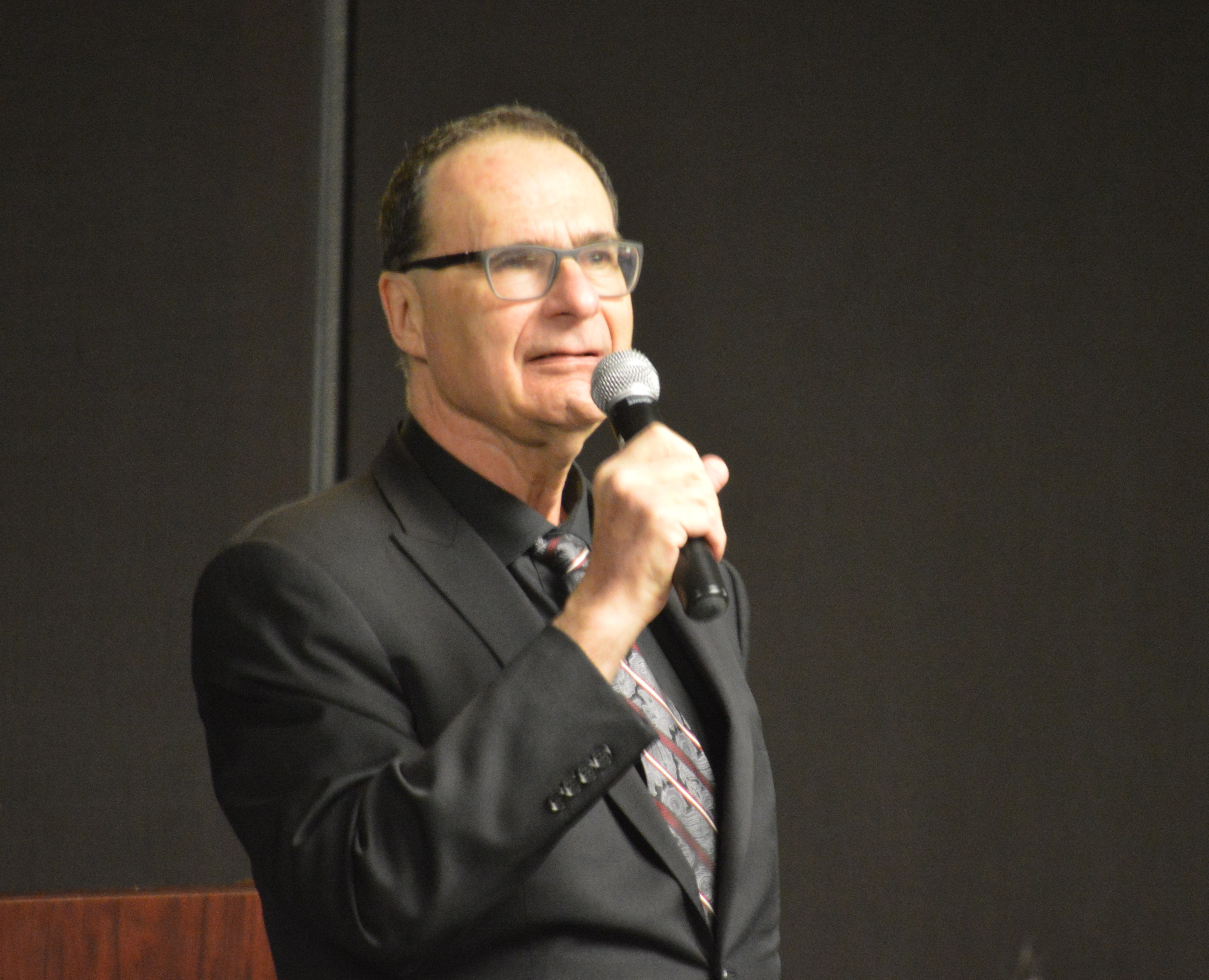
Rabbi Lawrence Hoffmanl speaks to a Loyola University crowd attended by members of the Jewish community of New Orleans on March 24. (Photo by Karen Lozinski)
In his own double helix – both visceral and erudite – Hoffman sees the two religions as siblings, formed together in the womb, and coming into the world at a critical time, when Jews were reinterpreting biblical scripture and Christians were telling the first stories of Jesus.
Hoffman’s lecture leads one on a journey through the commonalities of the two faiths via ritual, metaphor, culture, and history, pulsing with vitality and zest.
One of his first references was to Vatican II, calling it a “remarkable time, when dialogue replaces dissertation between Judaism and Christianity.”
From there, Hoffman brought attendees back to the First Century CE, asking them to look past the prevailing belief that Christianity emerged from Judaism to the truth that the two faiths – as we know them today – came into being together with the shift from biblical to rabbinic redefinition of Judaism in 70 CE and the writing of the gospels.
Since the Middle Ages, Hoffman noted, the two faiths have “swirled around each other, and not always happily,” but they are the same tradition branching off the Hebrew bible.
Hoffman’s winning combination of deep scholarship, affability, dynamism, and humor throughout his presentation underscored his confidence in the subject at hand. His delivery speaks to an assurance of the intelligence and receptivity of his audience, thus giving the lecture an ease of learning. Combined with Hoffman’s profound sagacity, passion for his subject matter and a positive worldview overall, this intellectual experience possessed a high level of intrigue and fun.
Anecdotally, he spoke about a class he taught at a Jewish summer camp for advanced children and an experience with a young girl who proved to be a listless student more interested in tennis than in religious tenets.
When Hoffman presented the story of the Last Supper to the children, and told them Jesus’ words, as he referred to himself as the bread, the young girl huffed and expressed how she thought that proclamation was “dumb.” Her reaction provided Hoffman with a springboard to answer questions existing between the faiths. In this way he hoped to find a better way to explain Christianity to Jews.
From that point he turned to bread, both in his scholarly life and in his lecture.
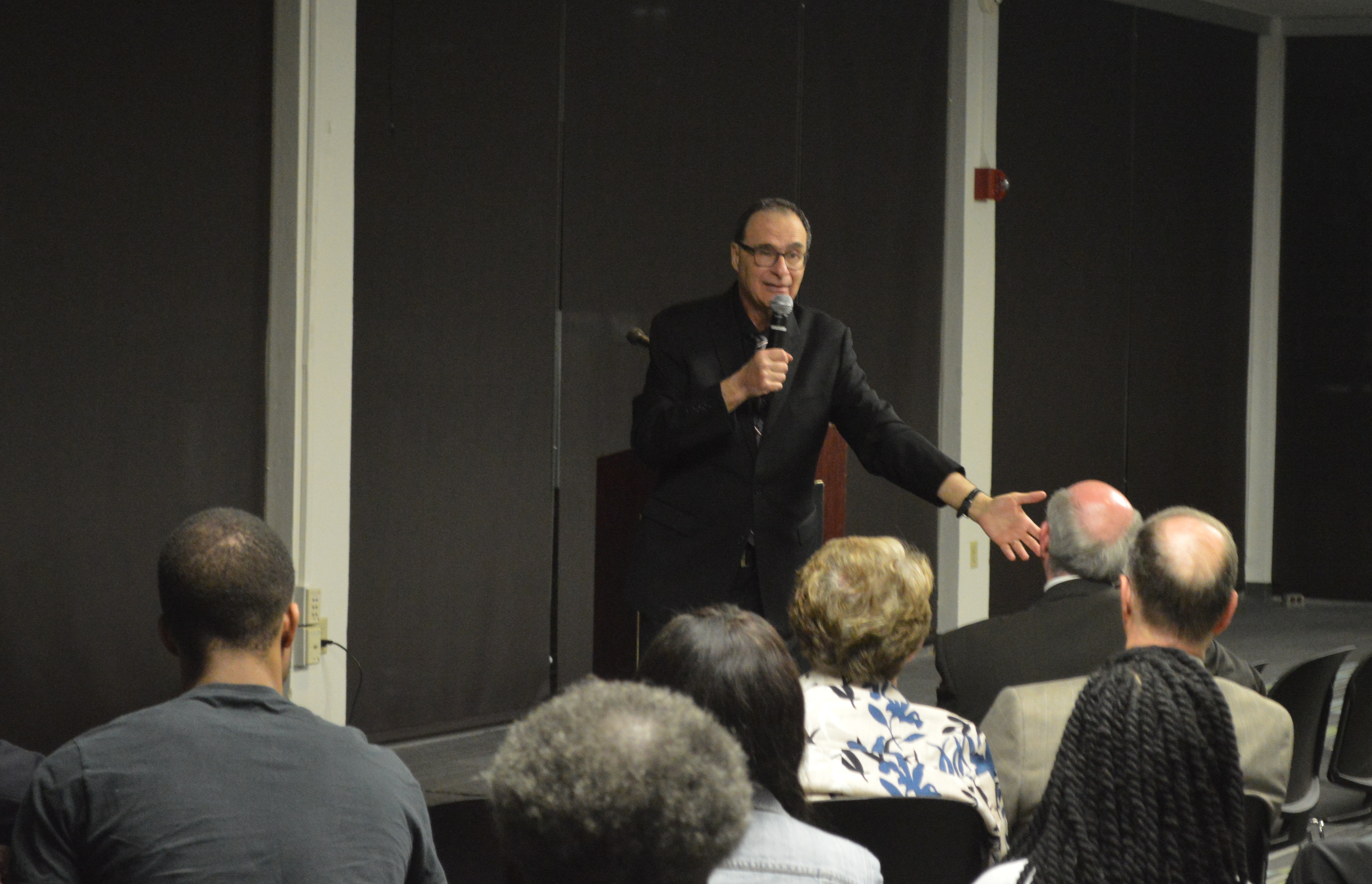
Rabbi Lawrency Powell at the Loyola University Danna Center. (Photo by Karen Lozinski)
He spoke of the eating of the afikoman, the piece of matzoh consumed as dessert at the end of a Passover Seder. Hoffman spoke of the rigid strictures governing its consumption during the meal, citing Judaism’s rhetoric of law versus Christianity’s rhetoric of theology.
After the destruction of the Second Temple and the shift to rabbinical Judaism, the bread became the equivalent of the Passover offering, in place of the paschal lamb. Jesus referred to himself in these terms, Hoffman explained, as the sacrificial lamb, with the bread as metaphor—a clever means of communicating with the Apostles, who were already engrained with the rites and rituals Jesus was referencing.
Hoffman illustrated the transformation of the symbolism of bread as salvation taking place far before the Last Supper. He traced it back to Genesis and the Garden of Eden, mentioning the bread tree as “the best tree from which to eat.”
Once cast out of Eden, the hardship of bread making was foisted upon the people, an arduous task many of us take for granted today, given the vast selection and wide availability of bread. Hoffman then explained that for rabbis, the distinguishing sign of paradise is the bread tree, and that these three representations are seen by Jewish theology as three eras: perfection in Eden, followed by the historical age in which people toil at bread making (in which we now exist), and the promise of redemption. Bread is the symbol of that redemption.
In an exclusive CCJN interview, Hoffman said he was delighted to spend time in New Orleans and become more acquainted with the diversity of the city outside the “glitz of the Quarter.”
Though his visit may have been brief – he spent Shabbat at Gates of Prayer Synagogue in Metairie – Hoffman was able to view several neighborhoods, now recovered from the flooding associated with Hurricane Katrina. He acknowledged that the changes he saw and the rebuilding process was an “enormously spiritual experience” for him. “(I am) filled with gratitude for the human spirit and humbled by the city and what it has managed to do,” he expressed.
Asked why people are drawn towards literal interpretation of religious texts, and if can they be encouraged to transcend this inclination, Hoffman replied that biblical literalists really aren’t what they believe they are—they are selective literalists, he said, with a purpose-driven selectivity. This is, itself, an interpretation, he proffered
Hoffman’s lecture also touched on topics such as the similarities between “The Lord’s Prayer,” found in the Christian canon, and the Kaddish, one of the most powerful prayers chanted by observant Jews.
He touched on the rabbinical practice of “table-ship,” during which a meal was eaten followed by ideally meaningful discussion. This he claimed is taken from pagan gorges and the philosophical debates that accompanied them.
Hoffman spoke about Jesus’ proclamation that the apostles “Do this in memory of me,” not as a literal command, but as to how the Talmud addresses the human boundaries of memory set against time and experience. Hoffman related that the phrase indicates the Hebrew interpretation of the term “pointer,” that Jesus was relating to his followers that he was their salvation.
Another salient point made by Hoffman was that Jesus’ use of bread as a metaphor is an egalitarian gesture—his followers also became the lamb, and “owned” it in this process, a reference to the collective ownership of the paschal lamb by multiple families without great means in pre-70 CE.
Ordained as a rabbi in 1969, Hoffman received his Ph.D. in 1973, and has taught regularly since then at the Hebrew Union College – Jewish Institute of Religion (HUC-JIR), in New York City. He additionally directed the HUC-JIR School of Sacred Music from 1984-1987.
Hoffman was named the first Barbara and Stephen Friedman Professor of Liturgy, Worship and Ritual in 2003. He teaches classes in liturgy, ritual, spirituality, theology and synagogue leadership. For almost 40 years, he has combined research, teaching, and a passion for the spiritual renewal of North American Judaism.
Hoffman has written or edited over 40 books, including My People’s Prayer Book (Jewish Lights Publishing), a ten-volume edition of the Siddur with modern commentaries, which was named a National Jewish Book Award winner for 2007.
His “Rethinking Synagogues: A New Vocabulary for Congregational Life” (Jewish Lights Publishing) and his “Art of Public Prayer” (Skylight Paths) are widely used by churches and synagogues as guides to organizational visioning and liturgical renewal.
In 2011, he received a second National Jewish Book Award for co-authoring “Sacred Strategies: Transforming Synagogues from Functional to Visionary” (Alban Institute).
His articles, both popular and scholarly, have appeared in eight languages and been published on four continents, and include contributions to such encyclopedias as The Macmillan Encyclopedia of Religion, The Oxford Dictionary of Religion, The Encyclopedia of Judaism and The Encyclopedia of Religion in America. He syndicates a regular column, which appears in The Jewish Week and The Jewish Times; and writes a blog entitled “Life and a Little Liturgy.”
The free lecture was sponsored by Loyola University’s department of Religious Studies in conjunction with and recognition of the Centennial Celebration of the Jewish Federation of Greater New Orleans, and with gifts from The Jewish Endowment Foundation of Louisiana, Lester and Beverly Wainer, The Luther and Zita Templeman Foundation, The Goldring Family Foundation, and the The Woldenberg Foundation.
The lecture was preceded by several light refreshments and snacks paid for with funds from the Jewish Foundation of Louisiana.
