


Rabbis Reflect on Rosh Hashanah
By NICHOLAS HAMBURGER, SPECIAL TO THE CCJN
In anticipation of Rosh Hashanah, the Crescent City Jewish News spoke with four rabbis in the New Orleans area about their thoughts on the holiday, discussing in particular its relationship to personal change and time. Rosh Hashanah, which begins at sundown on September 20, marks the beginning of the Jewish New Year, and it is celebrated on the first and second days of Tishrei, the seventh month of the Jewish calendar. The holiday commences the period of ten days between Rosh Hashanah and Yom Kippur known in Judaism as the High Holy Days, or the Days of Awe.

Rabbi Deborah Silver of Shir Chadash and Rabbi Robert Loewy of Congregation Gates of Prayer (photo by Alan Smason)
In a phone interview, Rabbi Robert Loewy, the rabbi of Congregation Gates of Prayer, emphasized the concept of change: “Rosh Hashanah and Yom Kippur are all about change, adjusting to change, and changing ourselves.” After 34 years, Loewy will be stepping down from the pulpit at Congregation Gates of Prayer, the Reform synagogue in Metairie, and he stated he will discuss this particular shift when he addresses his congregation on Rosh Hashanah.
“While much of this congregation and many of the congregants are linked to me personally, when the next year comes I hope they are going to be open to a new rabbi who will bring different qualities, values, characteristics, and enthusiasm,” Loewy said. “The concept of teshuvah is: are we willing to change?”
Teshuvah, which in Hebrew literally means “repentance,” is a period of intensive self-reflection undertaken by many Jews during the High Holy Days. But as Rabbi Deborah Silver, the rabbi of Metairie’s Shir Chadash Conservative Synagogue, points out, the word carries other resonances. “My preferred translation of teshuvah is ‘change,’” said Silver, who holds a degree in the Theory and Practice of Literary Translation from the University of Essex, England.
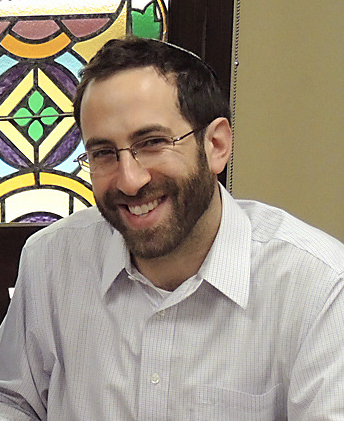
Rabbi Gabriel Greenberg of Congregation Beth Israel (photo by Alan Smason)
Rabbi Gabriel Greenberg, the rabbi of Congregation Beth Israel, a Modern Orthodox synagogue also located in Metairie, expanded on this idea: “We often find that our struggles from year to year remain the same, whether spiritual, personal, individual, or collective. We pray that this year will finally be the one where we are able to change our lives for the better in whatever way we need to.”
Though Rosh Hashanah celebrates the beginning of a New Year on the Jewish calendar, the holiday also marks a period of remembrance. “Rosh Hashanah is a great example of Judaism’s approach to time more generally,” Greenberg wrote in an email. It is, according to Greenberg, an “intersection between the . . . cyclical nature of time,” and the “linear nature of time we’re more used to.”
Rabbi Matthew Reimer, the senior rabbi of Temple Sinai, one of two Uptown Reform synagogues, elaborated on a similar idea: “Time is both always moving forward and cyclical. Our Jewish calendar is the perfect example of that. We repeat everything, right down to our very text — we read it every single year.” Reimer probed the holiday’s approach to time by posing a question. “Knowing that time is always moving forward, how do you then address the fact that you’re doing a review of the year that was, in order to look ahead?”

Senior Rabbi Matthew Reimer of Temple Sinai (photo by Alan Smason)
In Judaism, this remembrance is referred to as zichronot, which is sounded by the second of three blowings on the shofar, an act that is performed in services on Rosh Hashanah and Yom Kippur. Loewy described zichronot as the moment when “we remember the moments of interaction over time” with God and, furthermore, as when “we remember the sense of a covenant that we have with God.” He continued: “Honoring memory is a way not only to honor those that went before us, but it also is a reminder of who we are as a result of who they were.”
The four rabbis will speak about a variety of topics when they address their respective congregations on Wednesday night. Reimer plans on emphasizing the importance of personal happiness to his congregants at Temple Sinai before he transitions to a sermon against anti-Semitism. “Happiness is as much a part of who we should be as Jews and as humans as anything else,” he said.
Silver plans to center her sermons at Shir Chadash around the concept of renewal. “I feel that over the past year it’s been a difficult world to live in,” she said. “Our sensibilities are getting pummeled over and over again. The idea that this is a season in which we renew our hearts will be running as a theme throughout everything that I talk about.”
While Loewy plans to discuss the imminent change in rabbis at Congregation Gates of Prayer, down the street at neighboring Beth Israel, Greenberg will focus, in part, on the recent hurricanes that have devastated various communities in the United States and Caribbean islands. In the wake of the destructive natural disasters, Greenberg noted, “It makes sense to say that, in the Rosh Hashanah liturgy, God is a god of mercy.”
Twelve years after the catastrophic flooding of Hurricane Katrina, Greenberg’s discussion of the recent hurricanes will likely be a poignant subject for his congregation, which moved to Metairie after Katrina floodwaters destroyed the congregation’s former location in the Lakeview neighborhood of New Orleans.
On that note, Silver offered insight into the significance of celebrating Rosh Hashanah and the High Holy Days in New Orleans. She observed that New Orleans is a place that has “the capacity to celebrate what is here and to take joy in what is ephemeral. And that flows from a deep familiarity with what it means to be fragile.” That feeling, Silver continued, is “very High Holy Days.”
