


Trump says US aid to Israel will stop at the end of the year
By SAM SOKOL
(JTA) — President Donald Trump on Tuesday morning said that the United States would halt billions of dollars in annual aid to Israel by the end of 2026, potentially ending decades of military funding for one of America’s closest allies in the Middle East.
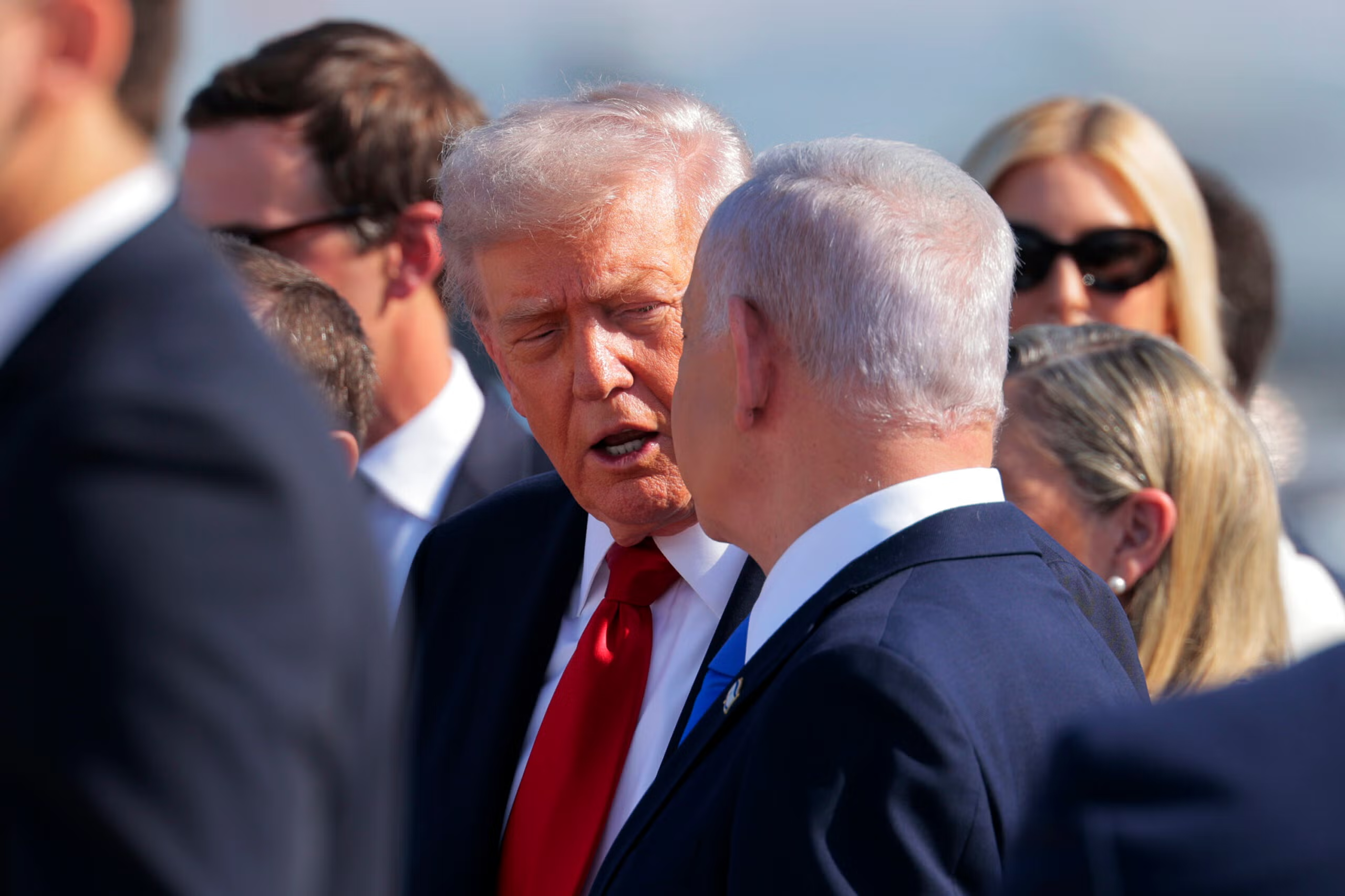
U.S. President Donald Trump speaks to Israeli Prime Minister Benjamin Netanyahu at Ben Gurion International Airport on Oct. 13, 2025, in Tel Aviv, Israel. (Chip Somodevilla/Getty Images)
“We were giving them $4 billion. We are. But it gets cut off at the end of the year,” Trump declared during a call-in appearance on the “Fox & Friends” morning program on Fox News. Israel’s 10-year memorandum of understanding (MOU) with the United States, which currently gives Israel $3.8 billion annually, runs through 2028, so it’s unclear how easy it would be for the White House to stop the funding this year and whether Trump is truly committed to changing the arrangement.
“It’s a bad talking point,” Trump said in reference to the aid, questioning why Republicans should have to deal with criticism from hardline pro-Palestinian Democrats like Michigan Democratic Senate candidate Abdul El-Sayed over it. His comments came as Americans across the country are voting Tuesday in midterm elections, including Michigan’s, that will determine control of the U.S. House and Senate.
“If they did need it, I would say keep it going,” Trump said of Israel’s budgetary situation. But referring to Israeli Prime Minister Benjamin Netanyahu’s statement in January that he wanted to taper off aid to zero at some point in the future, Trump said, “we give them more than anybody else and they no longer need it.”
Trump added that he’d reached an agreement with Netanyahu on the issue, telling Fox News that Netanyahu was the one who raised the issue given the Democratic opposition to the continued funding: “He brought it up. He said, ‘I think it would be appropriate if we do not receive aid,’ because he understands that this is one of their points of contention.”
A growing number of Democratic congressional candidates across the United States have campaigned on a platform of reducing or halting military aid to Israel during the run-up to Tuesday’s midterms. This April, dozens of senators — almost all of them Democrats — voted in favor of a failed motion to block the sales of certain weapons to Israel.
Trump also joked about moving to Israel if his political fortunes flag in the United States, telling Fox that he was “at 99% approval rating in Israel” and “if people got tired of me in the U.S., I’ll move to Israel and become prime minister.”
While the Prime Minister’s Office did not respond to the Jewish Telegraphic Agency’s request for comment, Israeli financial and military officials expressed surprise and concern at Trump’s announcement in anonymous comments made to various Hebrew media outlets.
Gadi Eisenkot, the chairman of the opposition Yashar party, the second-largest in Israel behind Netanyahu’s Likud following elections last Tuesday, argued that “the fact that the defense establishment—along with the citizens of Israel—learned of a shift in the strategic relationship through the media, demonstrates just how much Benjamin Netanyahu’s conduct poses a real danger.”
Yair Golan, chairman of Israel’s liberal Democrats party, also slammed Netanyahu in the wake of Trump’s statement, tweeting that “precisely at a time when Israel’s defense spending has reached enormous proportions, when Israel needs to replenish its offensive weapons stockpiles, and after air defense capabilities have been depleted following such a long war—Netanyahu logs another massive failure under his name.”
“The cessation of U.S. aid is heavy damage to Israel’s security” and “a responsible prime minister would have fought to increase American aid, not eliminate it,” added Golan.
Eisenkot and Golan are allies in the opposition, which is trying to form a wide enough coalition to oust Netanyahu from power following the elections last week.
The hawkish Zionist Organization of America, which has traditionally supported Trump, also criticized the president’s move, with its president, Morton Klein, questioning “why the U.S. isn‘t also ending the over $4 billion in annual U.S. aid to the Arab Muslim countries of Egypt, Jordan, Pakistan and Lebanon, and the Palestinian Authority entity.”
However, Republican Jewish Coalition CEO Matt Brooks took a different tack, arguing that under Trump, the U.S.-Israel relationship was “stronger than ever” and that “the process of weaning foreign military assistance to Israel is not unexpected and is something that has been openly discussed in partnership and coordination between the governments of the United States and Israel.”
Brooks added, “Ultimately what will come out of this will be to the benefit of both countries and strengthen our cooperation even further.”
On the other side of the political spectrum, Ilan Goldenberg, the chief policy officer of J Street, the liberal Jewish Middle East advocacy group, tweeted that “2 years ago on Election Day Trump was promising peace in the Middle East. This time ending FMF [Foreign Military Financing] to Israel. Goes to show how much things have moved politically, and simultaneously how much we can’t trust what he says to actually happen.”
Trump’s announcement additionally faced criticism from Brett McGurk, a former senior national security official who played a central role in the Biden administration’s handling of the Israel-Hamas war.
“Obama-era MOU provides $3.3B annually in military financing plus $500M for missile defense. Nearly all of these funds must be spent on purchases from US industry, supporting US jobs. The total is less than one-tenth of one percent of federal spending annually,” noted McGurk in a post on Twitter.
“Phasing out the MOU early is a decision for the President and Congress. It may be time to do so but the debate should start with accurate facts and figures,” he said.
The MOU is not “not legally binding” and the funding must be approved by Congress each year, noted Lara Friedman, the president of the progressive Foundation for Middle East Peace. Accordingly, the issue isn’t set to be revisited until the next budget is presented and then both Republican and Democratic senators and representatives would weigh in.
Michael J. Koplow, the chief policy officer at the dovish Israel Policy Forum, said that in addition to no such budget having actually been presented, it was important to note the timing of Trump’s remarks on Election Day. Republicans are facing several hard congressional battles in places like Michigan, where progressive Democratic candidates are calling to curtail aid to Israel.
“I think he’s trying to say to voters in Michigan, this isn’t actually an issue you should be voting on because the money is going away anyway,” Koplow assessed.
While there is growing support in the United States for cutting defense aid to Israel, there has also been a push among some members to more tightly integrate the two countries’ defense establishments, with a group of lawmakers seeking to include language in the annual defense policy bill that would expand U.S.-Israeli defense technology cooperation.
A section of the National Defense Authorization Act for 2027 would require the secretary of defense to designate an “executive agent responsible for synchronizing cooperative efforts between the United States and Israel, including bilateral defense technology research, development, testing, evaluation, integration, and industrial cooperation.”
