


While AIPAC’s critics rejoice as lobby shifts strategy, its defenders push back
By SHARON UDASIN
(JTA) — AIPAC’s critics gloated on Thursday after the pro-Israel lobby announced that it was ending direct contributions and candidate endorsements. But defenders of the storied Washington institution pushed back at that characterization, saying instead that the organization had made a smart course correction amid strong political headwinds stoked at least in part by antisemitism.
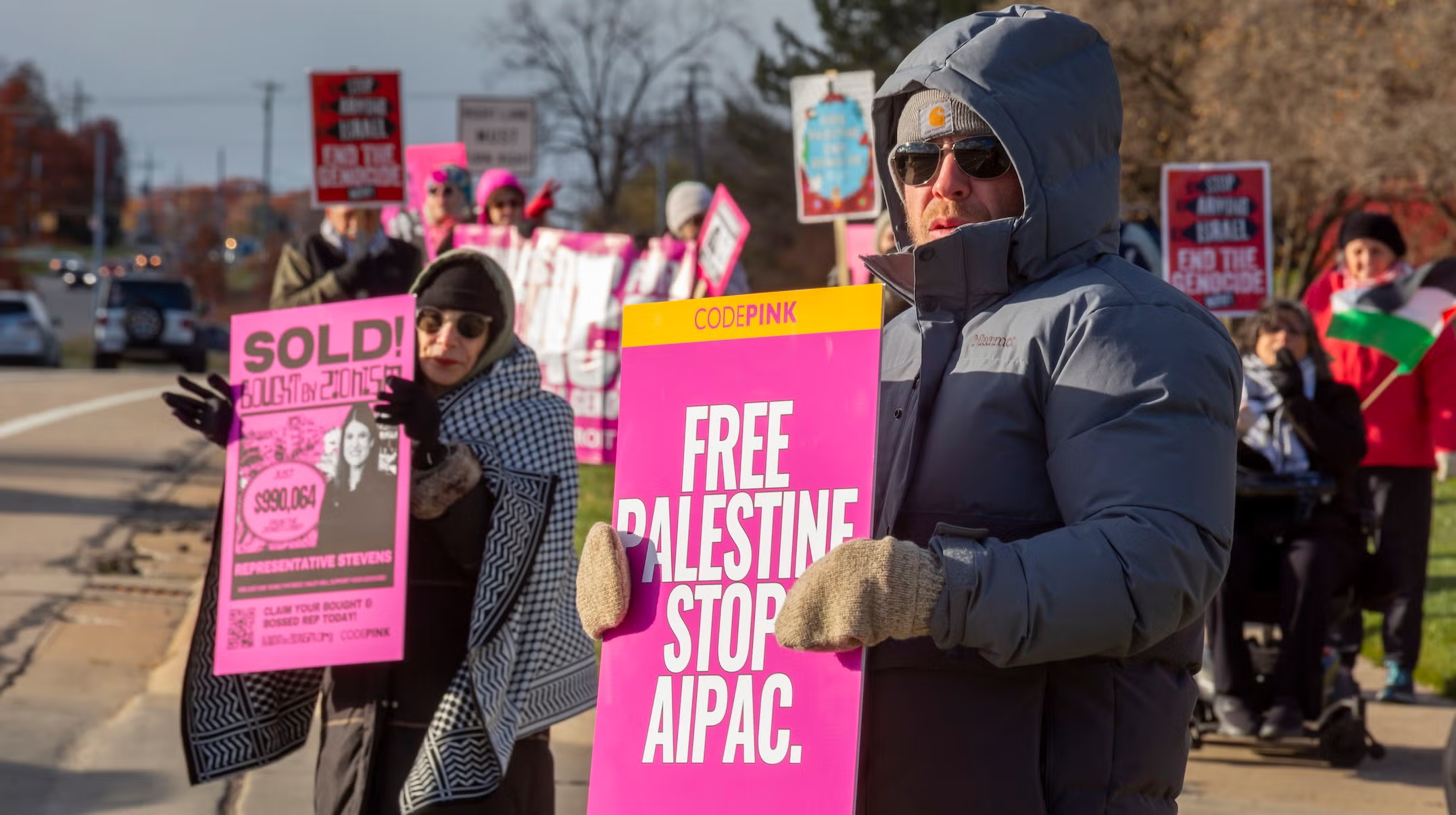
Activists picket U.S. Rep. Haley Stevens’ suburban Detroit office to protest her acceptance of campaign funding from AIPAC, in Farmington Hills, Michigan on Nov. 10, 2025. (Jim West/UCG/Universal Images Group via Getty Images)
The American Israel Public Affairs Committee announced the decision in a letter to its members on Wednesday, explaining that the lobby would now shift its focus to mobilizing individual donors. The abandonment of direct PAC contributions and candidate endorsements marks a significant reversal in a strategy that AIPAC launched in 2021, ahead of the 2022 election cycle. The letter informed donors that AIPAC’s super PAC, the United Democracy Project, also launched in 2021, would continue to operate.
The move came in an increasingly tense political cycle for AIPAC, which it called “one of the most challenging environments in recent memory.” The lobby has become a target for progressive candidates, particularly Democratic Socialists of America members, who have sharply criticized candidates who receive donations from AIPAC. In turn, the organization has become a symbol of undue political influence among some voters.
The DSA responded to the lobby’s policy shift by saying that “AIPAC has realized what we all already knew: working people do not want their tax dollars to fund apartheid and genocide.”
Kenneth Roth, former executive director of Human Rights Watch and a staunch Israel critic, wrote that AIPAC’s decision shows that “candidates don’t want its backing,” while the anti-Zionist group Jewish Voice for Peace posted that AIPAC was now deeming itself “too toxic.”
Jeremy Ben-Ami, president of the liberal pro-Israel lobbying group J Street, which has frequently tangled with AIPAC on social media, argued in a statement that “AIPAC can’t save its brand by folding its PAC.” Describing AIPAC as “a once-revered organization,” he said the lobby became toxic not due to its support of candidates but “because of the policies it asks those candidates to defend.”
But those with ties to AIPAC defended the move as one that will actually help the lobby fortify its impact. “It’s a marker of institutional health when they can look around at the reality, see it for what it is and change themselves accordingly,” Jonathan Greenberg, director for combatting antisemitism at Defending Education and a former AIPAC staffer, told the Jewish Telegraphic Agency.
“They recognized that their political ground had shifted and that they needed to change with that shift,” added Greenberg, who served as AIPAC’s Midwest political director until 2011 and ran for state office in Illinois as a Republican a year later.
Calling out what he described as a “horrifying demonization campaign” against AIPAC in Washington, he said he believes that the lobbying group made this strategic decision in an effort to continue operating amid widespread antisemitism.
“The pro-Israel community is still going to be deeply involved in campaigns,” added Greenberg, who identifies as a political conservative but no longer a Republican. “AIPAC is just wisely understanding that the way the organization operates can change, so that it can still be the voice that it’s always been on Capitol Hill.”
Recognizing that the U.S. political landscape is undergoing profound changes amid deep dissatisfaction across party lines, a former AIPAC spokesperson who requested anonymity to speak freely pointed out that institutions must evolve to stay effective. Other major interest groups, such as the pharmaceutical, hospital and real estate industries, are advancing their priorities with a variety of tactics, including lobbying, direct contributions, super PACs and networks of donors, the person noted.
In fact, one point of agreement on Thursday between AIPAC’s supporters and detractors was that the 72-year-old institution wasn’t going anywhere. “Mobilizing greater resources for AIPAC, pro-Israel candidates, and our super PAC is critical,” the AIPAC letter stressed, as it pledged to reinvest in its long-standing network of members nationwide.
“AIPAC staff and local leaders will continue working with you on political fundraising efforts, recommending contributions to candidates who are worthy of your support, and ensuring your resources are deployed in the most effective ways possible,” the letter added.
Indeed, opponents of the lobby indicated that the change in approach did little to satisfy them – and potentially opened up new lines of attack. DSA charged that AIPAC would “try to bankroll the same candidates under a different name.”
“You can’t hide AIPAC,” the DSA added. “The world has woken up.”
J Street’s Ben-Ami maintained that AIPAC’s decision to keep its super PAC even as it dropped its PAC “only doubles down on the dark money politics that helped create its problem in the first place.” Traditional PACs can contribute a maximum of $5,000 to individual candidates in each race, while super PACs can spend unlimited funds to independent political communications that serve to support or oppose candidates. Both have to disclose their donors, but super PAC donors aren’t always transparent about the origins of their money.
Tali deGroot, J Street’s vice president of political and digital strategy, likewise assessed that AIPAC’s influence wouldn’t disappear in the next election cycle.
“Instead, AIPAC’s donors and its super PAC will keep spending heavily in our elections, only now voters will have a harder time seeing where that money comes from,” deGroot said.
Defending Education’s Greenberg acknowledged that AIPAC’s choice to increase its reliance on its super PAC could fuel even more opposition to the lobby.
“But I don’t think fashioning ourselves to placate antisemites gets us anywhere,” he continued. “What we know about antisemites, from thousands of years of dealing with them, is that if we don’t give them this reason, they’ll find another reason.”
The former AIPAC spokesperson said the jury was out on whether the AIPAC pivot would improve its public image. “The question is whether AIPAC’s shift reflects a broader evolution in how organizations and interest groups engage politically, and whether changing its approach will change how the public perceives its influence,” the former spokesperson noted.
