


Jews and Jazz (Part Two)
By ALAN SMASON
(Editor’s Note: This article is a continuation on the influence of Jews on the development of jazz as an art form. While part one of “Jews and Jazz” focused on the local Jewish community, part two focuses on the prominence of famous Jews in its development nationally and internationally.)
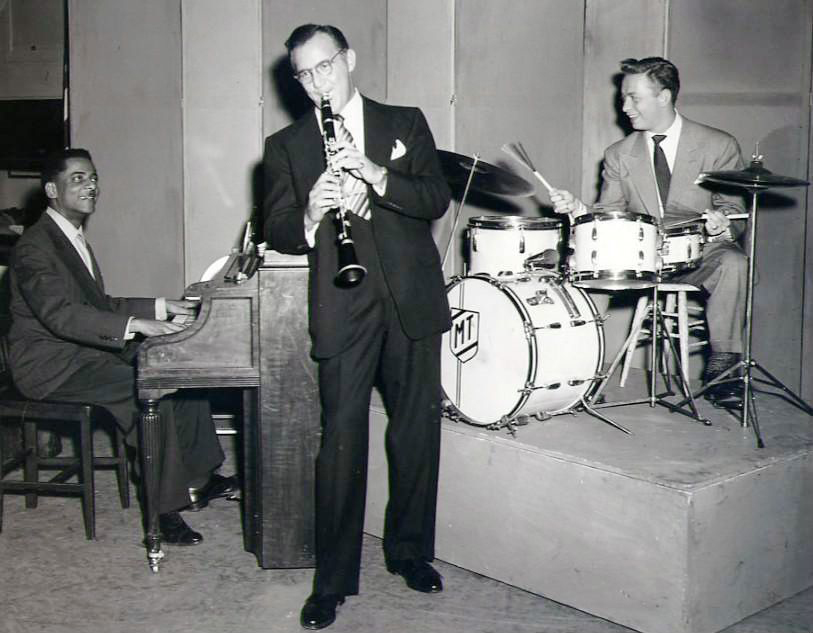
Teddy Riley, left, joined Benny Goodman, center, and Jewish drummer, singer and songwriter Mel Tormé. (Photo courtesy of the National Museum of American Jewish History.)
If jazz had its birthing process in New Orleans, then it’s first formative steps as a toddler were taken out of town in Chicago and later in New York.
Chicago produced Jewish pianist Art Hodes and drummers Vic Berton (whose original family name was Cohen) and Ben Pollack.
Although some have questioned his playing technique, Pollack established himself as a noted drummer in the early 1920s in Chicago through his association with the New Orleans Rhythm Kings. Pollack’s influence was such that he fronted for an amazing number of stars that would go on to much more brilliant careers than his own during the Swing and Big Band Eras.
Pollack fronted his own big band in the Park Central Hotel In New York. Among the stable of performers he introduced were Glenn Miller, Jimmy Dorsey, Jimmy McPartland, Muggsy Spanier, Bud Freeman (whose father, a tailor, was Jewish) and an upcoming clarinet player named Benny Goodman.
Goodman, who has been credited at having broken the race barrier in music, was actually not the first Jewish bandleader to invite African-Americans to play with him on recording sessions. Big band leader Ted Lewis, who was also Jewish, apparently included Fats Waller on a session in 1931, according to author Michael Gerber in his book “Jazz Jews.”
Goodman accompanied Bessie Smith on her final recordings and on Billie Holiday’s debut sessions in 1933, only a few weeks later. But the Holiday recordings were recorded in secret without any photos that might have attested to their historical importance. The American public was not ready to see whites and blacks play together, Gerber asserts.
However, when Goodman and his Catholic drummer Gene Krupa invited black pianist Teddy Lewis to join them in 1935 and form the Benny Goodman Trio, history was made. In August, vibraphonist Lionel Hampton officially made the group a quartet. Beginning the next year, Goodman toured with the quartet providing breaks between his big band.
The swing era was often credited as having begun when Goodman’s big band and his quartet performed at a sold out concert on January 16, 1938 at Carnegie Hall along with members of the Count Basie and Duke Ellington Orchestras.
Another Jewish big band leader and exceptional performer was Goodman’s fellow clarinetist Artie Shaw, whose real name was Arthur Jacob Arshawsky. Unlike Goodman, though, Shaw attempted to cover up his Jewish heritage by changing his name and attempting to deny his Jewishness.
Ironically, one of his early friends, Willie “The Lion” Smith was a light-skinned black man who claimed a rare Jewish parentage. Smith’s Jewish father, Frank Bertlehoff, was given the boot by his girlfriend, who later married Smith’s stepfather and gave her son his surname. Smith, who considered himself Jewish, even went by his Yiddish name of Velvala, according to Gerber.
The heyday of the swing and big band eras included many well-known Jewish musical figures. Included in this number were trumpeters Ziggy Elman, Les Elgart, Max Kaminsky and Charlie Spivak; trombonists Si Zentner and Buddy Morrow; drummers Buddy Rich and Shelley Manne; saxophonists Larry Elgart, Bud Freeman and Boomie Richman; pianists Joe Harnell, Joe Bushkin, Milt Raskin and Mel Powell; and a host of others.
Popular Jewish singers from the era with major jazz influences were Mel Tormé, Dinah Shore (real name Frances Rose Shore), Georgia Gibbs and Al Jolson, considered “the world’s greatest entertainer” and, at the height of his fame, the most famous and highest paid performer in America.

Irving Berlin in his World War I uniform became known as the “King of Ragtime.” (Photo courtesy of the National Museum of American Jewish History.)
While Louis Armstrong performed some of his early singing career in whiteface, Jolson became the archetypal white performer playing in blackface. His early association with another Russian-born Jew, Irving Berlin (born Israel Baline), known as “the King of Ragtime,” became the stuff of legend.
Jolson’s depiction of the fictional Jakie Rabinowitz, in the 1927 musical film “The Jazz Singer,” was frighteningly similar to his own experience. Like the fictional Rabinowitz, who altered him name in the film to the more mainstreamed Jack Robin, Jolson, also the son of a cantor and a rabbi, changed his name from Asa Yoelson.
According to Lisa Naomi Silberman Brenner, the ability for Jews to obfuscate the lines of racial identity by performing in blackface accomplished an important task. “Conflating Jewish identity with Black identity allows the Jew to remain marginalized while at the same time engaging in American popular culture,” she writes in her paper “The Jazz Singer’s Legacy: Racial Role-Play of African-Americans and Jews in 20th Century American Performance.”
“By blacking up and singing ‘Mammy’ at the end of the film, Robin has not only changed his genealogy, but he has also blurred the racial makeup of his mother,” Brenner suggests. “In other words the Jew has reconstructed his identity.”
There is also the commonality of expression between the oppressed slaves of the African-American and ancient Hebrew experiences. Jewish scholar Irving Howe sees blackface as “a mask for Jewish expressiveness, with one woe speaking through the voice of another.”

Al Jolson, considered the greatest performer of the first half of the Twentieth Century, oftentimes performed in blackface. (Photo courtesy of the National Museum of American Jewish History.)
Jolson may have been the most well known of blackface performers appearing in vaudeville and its less regarded cousin, burlesque, but he was certainly not alone. Among the Jews whom Brenner gives as examples of performing in blackface are Fanny Brice, George Burns, Eddie Cantor, George Jessel and Sophie Tucker, certainly the cream of the American entertainment field of the day.
Tucker first appeared on stage in vaudeville in 1907 and joined a burlesque troupe a year later in Pittsburgh. Because of her girth, she was advised to perform in a thick southern accent and to wear blackface because she would be taunted. When her luggage, including her makeup kit was lost, Tucker was forced to go out on stage without the blackface or the accent.
She never returned to the practice and began to sing “fat girl” songs like “Nobody Loves a Fat Girl, But Oh How a Fat Girl Can Love” and “I Don’t Want to Be Thin.” Only a year later, Tucker was performing as a headliner at the Ziefeld Follies.
While her popular repertoire never did establish her strictly as a jazz performer, she has been credited as incorporating a number of jazz devices in her act through the several jazz players who were in her supporting orchestra and the friendship she maintained with fellow performers Mamie Smith and Ethel Waters. It was Waters who was credited with exposing Tucker to jazz in the 1920s and to appreciate it as a true American art form.
Again, while the influence of jazz ran across all ethnic groups, the members of the extended Jewish community did much to establish it and to promote it through their drive and industry. We have seen how the local New Orleans Jewish community embraced jazz in the “Satchmo and the Star” and “Jews and Jazz, Part One” articles. Now we have come to learn of the importance of Jews in its development and promotion across the nation and around the globe.
