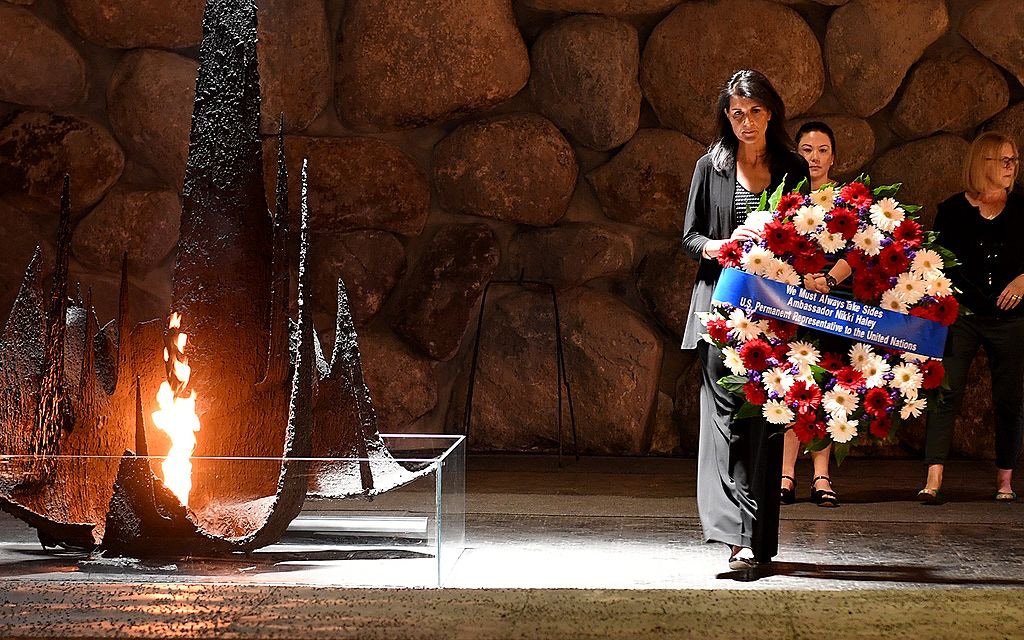
Nikki Haley has recently gained some traction in the race for the Republican nomination for president, though she still significantly trails frontrunner Donald Trump. And she is struggling to overcome the criticism she received for responding to a question about the cause of the Civil War without acknowledging slavery. Haley served as ambassador to the United Nations under President Trump, where she was a staunch defender of Israel, saying among other things “The [UN’s Human Rights] Council must end its practice of wrongly singling out Israel for criticism.” She recently said in an interview, “I hope that everyone will remember what a good friend I was to Israel and know that I would never let up on that.” Nikki Haley has received praise from many Israelis, including which of the following?
A. Prime Minister Bibi Netanyahu issued a statement when Nikki Haley announced her run, saying, “Israel never had a better friend in the United Nations than Nikki Haley. If she is elected president of the United States I have no doubt that she will continue to be a fighter for Israel and Jews worldwide.”
B. Israeli model and actress Gad Gadot met Nikki Haley at the 2019 AIPAC in Washington, DC when Gal Gadot was a speaker in a session titled, “Obstacles and Opportunities: Women of a Start-Up Nation.” When Haley announced her candidacy, Gadot tweeted that “Nikki Haley is an American politician who understands Israel’s needs, and she is a woman who can lead in what is still in so many ways a man’s world.”
C. When Haley announced her bid for the presidency, Danny Danon, former Knesset member and Israeli ambassador to the United Nations tweeted “Nikki is a true friend of Israel. I have no doubt that she will always stand by our side. Likewise, Israel will always be the closest ally of the US. Good luck Nikki!”
D. Author and journalist Yossi Halevi Klein said last year about Haley, “It is not my place to tell Americans who to vote for. But what I can do is tell Americans who would be good for Israel. Nikki Haley is the only Republican candidate at this point who fits that description. She understands Israel and recognizes that the United States must support Israel. But from her time at the United Nations, she also understands the challenge of finding a way to expand Israel’s relationship with moderate Arab nations.”
E. The Jerusalem Boys Choir recorded and posted a song titled Nikki Haley, Running For The Top, with lyrics including “Who is that flying high?/Beautiful as the moon/Her hair flows like the Mountains of Gilead.”
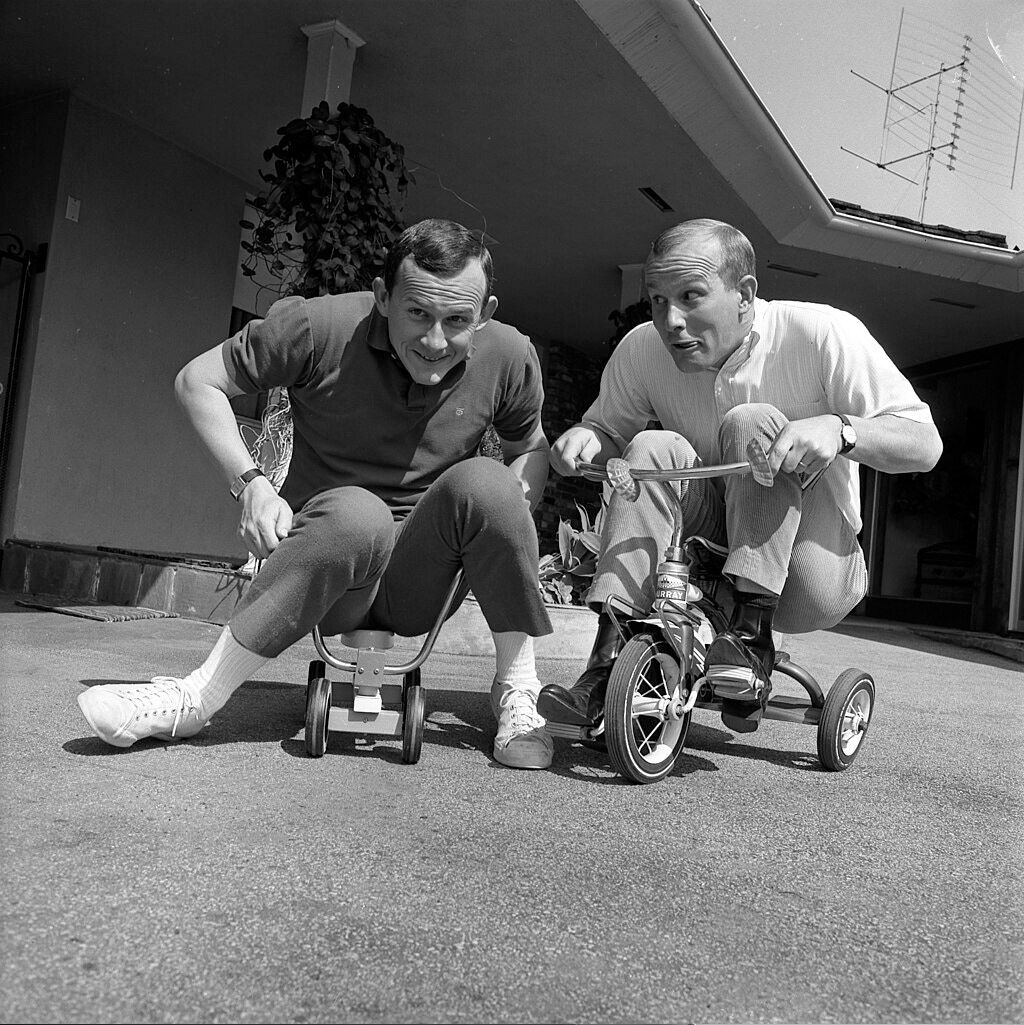
Tommy Smothers, half of the Smothers Brothers comedy team, passed away last week. The Smothers Brothers combined music, humor, and their playful sibling rivalry (Tommy’s trademark retort to Dick was “Mom always liked you best”) to entertain, while also emphasizing political satire and liberal politics as part of their presentation. The Smothers Brothers Comedy Hour made its debut on CBS in February of 1967, but was abruptly canceled in April 1969 after many fights between the brothers and the network. Controversy surrounded sketches which included the words “breast” and “heterosexual,” as well as musical guests including Pete Seeger performing the anti-war song “Waist Deep in the Big Muddy” and Harry Belafonte singing “Lord, Don’t Stop the Carnival” as a protest against the violence-filled 1968 Democratic National Convention in Chicago. Both of those musical performances were pulled from the broadcast. The Smothers Brothers Comedy Hour also featured performances by comedians including George Carlin, Bob Newhart, Steve Martin and many others. One sketch which is included on The Smothers Brothers Comedy Hour: Best of, Vol. 2 is entitled Talking Jewish. In this bit, Tommy Smothers introduced their guest as “one of the chosen people,” and went on to tell the guest that “both my brother and myself have always liked your act because you do great shtick,” which he described as “a show biz phrase.” The Smothers Brothers and this guest continued to joke back and forth about “Jewish” words and accents. Who were the Smothers Brothers bantering with in the Talking Jewish sketch?
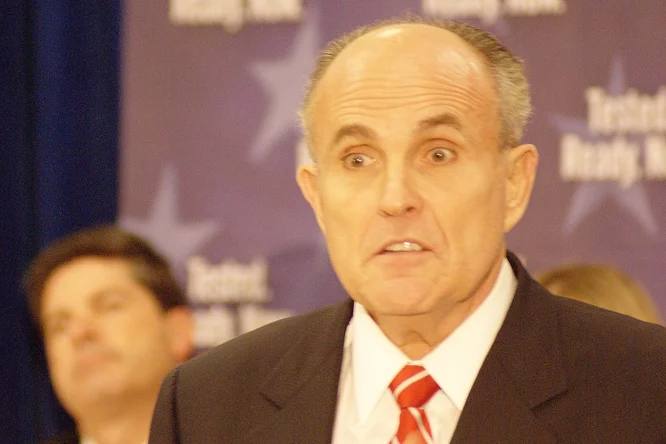
Rudy Giuliani was recently found liable for defamation after making false claims against two Georgia election workers, following the defeat of Donald Trump in the last presidential election. Last week Giuliani was ordered to pay retribution of $148 million to the victims, which led him to declare bankruptcy. Meanwhile, Giuliani continues to repeat his false claims, stating that “Everything I said about them is true.” This is not the only time Giuliani has been brought into court. He was sued for sexual assault and harassment by a former associate in a case which led to revelations of recordings wherein Giuliani made many controversial statements. Some of those statements included comments about Jews, including demeaning insults about Jewish men’s sexual prowess. In those tapes, Giuliani also criticized Jews for their celebration of what holiday?
Rudy Giuliani (2167875970) by Marc Nozell is licensed under CC BY 2.0 DEED, via Wikimedia Commons
A.Regarding Yom Kippur, he said, “Get over the Yom Kippur. This is 2018. You gotta eat, people.”
B.Regarding Passover, he said “Get over the Passover. It was like 3,000 years ago. The Red Sea parted, big deal. It’s not the first time that happened.”
C.Regarding Succot, he said, “Get over your Succahs. Those little huts are more ridiculous than those rat-infested COVID huts that restaurants are cluttering up the streets with.”
D.Regarding Chanukah, he said, “Get over that Chanukah. So the oil burned for a week. My oil burner has been working for years so who cares. Put up a tree and drink some nog like the rest of us.”
E.Regarding Tzom Gedaliah, he said, “Get over that Tzom thing. I mean really? A fast day to commemorate the assassination of Gedaliah? If you’re gonna skip a meal for every Jew who was ever killed then who’s gonna eat all of that disgusting chopped liver and gribenes?”
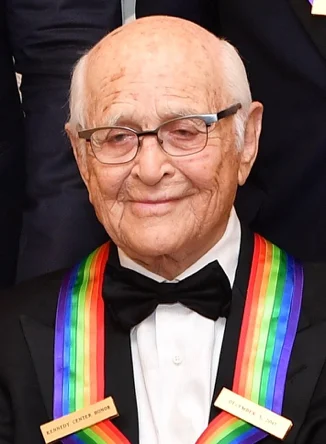
Norman Lear died last week at the age of 101. Lear was a writer and producer who created dozens of television sitcoms, including “All in the Family””>Sanford and Son, Maude, The Jeffersons, and One Day at a Time, among others. He received numerous awards for his work, including 6 Emmys, 2 Peabodys, the National Medal of Arts, and the Kennedy Center Honors. Lear was also very involved in progressive politics, most notably as a founder of People for the American Way, whose mission is to fight for equality, pluralism, freedom of thought, and compassion for others. Lear was born to Jewish parents in New Haven, CT, and though he was not religious, he described himself “as culturally Jewish as I could be and proud to be Jewish.” He noted that listening to the antisemitic Father Coughlin on the radio influenced his thinking and led him toward social activism. In 1974, Lear founded a production company whose name was influenced by his Judaism. What was the company called?
Norman Lear 2017 by U.S. State Department is in the public domain, via Wikimedia Commons
A.TAT Communications, from the phrase Tukhes Afn Tish, meaning “Buttocks on the table.”
B.Ken Men Productions, from the phrase Az me muz, ken men, which translates to “If you have to, you can.”
C.MTGL Productions, from the phrase, Mensch Tracht un Got Lacht, which means “Man plans and God laughs.”
D.CvC Communications, from the phrase Chas v’Chalila, meaning “God Forbid.”
Henry Kissinger died last week at the age of 100. Born in 1923 in Germany, Kissinger and his family fled the country in 1938 to escape increasing antisemitism, including beatings he suffered by Hitler Youth gang members. He went to college in New York, studying accounting, until he was drafted into the United States Army, where he served in the intelligence division during the Battle of the Bulge. After the war he received advanced degrees and was a faculty member in the Department of Government at Harvard University. He entered the political realm, working as a foreign policy advisor to Nelson Rockefeller, later becoming National Security Advisor under President Richard Nixon. He then became Secretary of State under Nixon as well as President Gerald Ford. He negotiated the cease fire that led to the end of the Viet Nam War, for which he won the Nobel Peace Prize. But he has also been viewed by many as a war criminal, responsible for the deaths of millions because of his policies in Southeast Asia, South America, the Middle East, and other areas of conflict. Kissinger was criticized for ignoring the plight of Soviet Jews, saying that “The emigration of Jews from the Soviet Union is not an objective of American foreign policy, and if they put Jews into gas chambers in the Soviet Union, it is not an American concern. Maybe a humanitarian concern.” He played a major role during the 1973 Yom Kippur War, facilitating negotiations that eventually led to an end to the war and a peace treaty between Israel and Egypt following the Camp David Accords. But Kissinger has been accused of delaying arms shipments to Israel during that war in order to force Israel into post-war diplomacy, a charge which Kissinger denied. Though raised Orthodox, Kissinger’s religious identity was complicated. He is reported to have said, “Is there a more self-serving group of people than the Jewish community?” What comment did Kissinger make in reference to his being born a German Jew?
and Israeli Prime Minister Golda Meir, meeting in the Oval Office 1973.gif by Atkins, Oliver F. is in the public domain, via Wikimedia Commons
A.“If it were not for the accident of my birth [at the beginning of the Nazi era in Germany], I probably would have been a rabbi instead of a refugee.”
B.“If it were not for the accident of my birth [as a non-US citizen], I could have been president of the United States.”
C.“If it were not for the accident of my birth [as a Jew], I might have been the German Secretary of State instead of the American Secretary.
D.“If it were not for the accident of my birth [as a Jew], I would be antisemitic.”
E.“If it were not for the accident of my birth [as a short bookish nerd] I could have been a tight end for the Kansas City Chiefs and dating Taylor Swift.
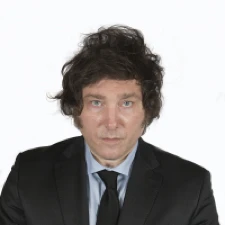
Javier Milei was just elected president of Argentina. Milei, an economist, author, politician, former tantric sex coach, and self-described “anarcho-capitalist,” is a right-wing libertarian and populist who supports freedom of choice on issues such as drugs, guns, prostitution, and LGBTQ issues, while opposing abortion. He believes that global warming is a “socialist lie” and has pledged to not raise taxes, noting that “I will never raise a tax, I will never create new taxes,” while also saying that “Jesus didn’t pay taxes.” Upon Milei’s victory in the presidential race, Donald Trump tweeted that “I am very proud of you. You will turn your country around and truly Make Argentina Great Again!” What connection does Milei have to Judaism?
Javier Milei by Cámara de Diputados de la Nación Argentina is in the public domain, via Wikimedia Commons
A.Though he is Catholic, he maintains a kosher-style diet, eating no pork products or shellfish, noting that “what works for Jesus’s people works for me.”
B.He studies Torah on a daily basis, commenting that “The rabbi who helps me study says that I should read the Torah from the point of view of economic analysis.”
C.His mother was Jewish and he attended Hebrew school as a child, but he later converted to Catholicism, commenting that “If I am to make my way in Argentina, I will need to do so with the support of the Holy Father.”
D.He considered converting to Judaism, but decided that becoming Sabbath-observant would interfere with his duties as president, saying “If I am president and Shabbat falls, what do I do? Are you going to disconnect from the country from the first star on Friday to the first star on Saturday?”
E.He is a strong supporter of Israel, often walked onstage at his rallies to the sound of a shofar, and has said, “I’m almost Jewish. I’m just missing the ‘blood covenant.’ ”
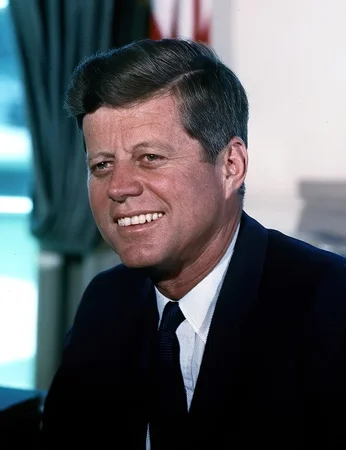
President John F. Kennedy was assassinated 60 years ago this week in Dallas, Texas. Kennedy was the son of Joseph Kennedy, Sr., a wealthy businessman and philanthropist. Joseph Kennedy was a known antisemite who, while he was serving as the United States ambassador to the United Kingdom in 1938, told the German ambassador that President Roosevelt was the victim of “Jewish influence” who was misinformed as to the “philosophy, ambitions and ideals of Hitler’s regime.” John F. Kennedy made many efforts to distance himself from his father’s views, both prior to and while serving as President. Which of the following is an example of John F. Kennedy’s positive connection to the Jewish community?
John F. Kennedy, White House color photo portrait by Cecil Stoughton, White House is in the public domain, via Wikimedia Commons
A.President Kennedy instructed one of his advisors, Lewis Weinstein, to organize a conference on the issue of Soviet Jews, who were being oppressed under the Soviet regime. Sadly, the conference never happened as Weinstein was only asked to do this days before Kennedy’s assassination.
B.It is well known that Robert Frost was one of the speakers at President Kennedy’s inauguration ceremony, the first time a poet participated in a presidential inauguration. It is less known that it was also the first inauguration in which a rabbi addressed the assembled, as President-elect Kennedy asked Rabbi Abraham Joshua Heschel to offer a benediction at the inauguration on January 20, 1961.
C.In 1947, John F. Kennedy won his first election, as a Congressman from Massachusetts’s 11th Congressional district. One of his first official acts was to co-sponsor a resolution supporting the United Nations partition plan for Palestine. At the time, Kennedy stated that “this is not a perfect plan, but it is the best plan to ensure the establishment of a Jewish state for survivors of the Nazi destruction.”
D.In August 1962, John F. Kennedy became the first American President to sell a major weapons system to Israel. The United States sold Hawk anti-aircraft missiles to Israel as part of a broader strategy of expanding the U.S. bilateral relationship with Israel, an ally of growing importance in the Middle East.
E.When Kennedy was running for president he campaigned in the Chassidic communities of Brooklyn. He appeared at a rally sponsored by followers of Rebbe Nachman, where at one stop he donned a yarmulke and uttered his famous line (later to be stated again in a slightly revised way), “Ich bin ein Breslover.”
Dr. Ruth was just named New York State’s Ambassador to Loneliness, with a charge to help New Yorkers cope with the loneliness epidemic. Dr. Ruth, the Holocaust survivor who gained fame as a sex therapist, says that she began focusing on this issue when she was isolated during the COVID lockdown, which reminded her that she had written in a childhood diary about being lonely. She located that diary from her time in Switzerland after World War II, and found this quote: “I live with 150 people — and am alone.” She also noted that she was “longing for a friend.” Ruth Westheimer emigrated to Palestine where she joined the Haganah at age 17 and suffered serious injuries in a mortar-fire attack during the War of Independence. She subsequently moved to Paris, studied psychology at the Sorbonne, later earning a masters degree in sociology and a doctorate in education in the United States. She taught at universities and established a practice offering sex therapy, eventually gaining a world-wide following from radio and television programs in which she discussed sexual issues with knowledge, frankness, humor and respect. What else is true about Dr. Ruth?
Ruth Westheimer (10877) by Rhododendrites is licensed under CC BY-SA 4.0 via Wikimedia Commons
A.When she emigrated to Palestine in 1945, she settled at Kibbutz Ramat David, where she lost her virginity on a hay stack.
B.She was the first female president of the Conservative Synagogue Adath Israel of Riverdale in New York, serving from 1986-1988.
C.While living in Paris in 1952, she had an affair with Edmond Adolphe de Rothschild, a member of the Rothschild banking family.
D.In 1967, Betty Friedan (whom she knew as a fellow member of the Hebrew Tabernacle Congregation of Washington Heights) recruited her to become involved in the National Organization for Women, where she headed up their Reproductive Rights campaign.
E.She was 27 years old before she learned that a brisket was not the thing that a mohel carried his tools in.
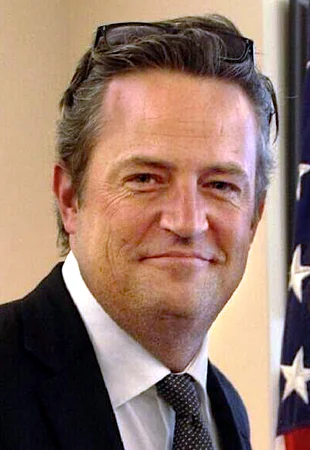
Actor Matthew Perry died tragically at the age of 54. Perry was best known for playing Chandler Bing on the sitcom Friends. Bing was not one of the Jewish characters on the show–among the six friends, Ross, Monica and Rachel were Jewish. Which Friends episode featured Chandler Bing with a Jewish component in the story?
Matthew Perry in support of Awareness on Drug Courts and Reduced Substance Abuses in the public domain, via Wikimedia Commons
A.The One With Chandler’s Work Laugh, the episode where Chandler’s on-again/off-again Jewish girlfriend Janice sleeps with Ross. When everyone learns of this dalliance, Ross says, “Okay, look, I-I know what you guys are going to say…” To which Phoebe replies, “You two will have very hairy children.” This is the only episode that Janice appears in where she does not nasally utter her classic line “Oh! My! God!”. But Chandler does utter that line (mimicking Janice’s nasal whine) when he learns that Ross slept with her. Janice replies to him, “Don’t you worry, Chandler Bing. I can handle lots of Jewish boys but you’re still the only goy for me.”
B.The One With All the Rugby, where Chandler wants to break up with Janice, but he can’t tell her. So he says that he’s being forced to move to Israel for work, leading her to go with him to the airport to see him off. Chandler approaches the airline counter and says quietly “I need one fake ticket to Israel.” Not understanding, the clerk tries to sell him a real ticket, leading Chandler to reply, “What would you give to a kid if he wanted a ticket to play with?” Ultimately Chandler purchased a $2100 ticket and boarded the plane as Janice says she’ll write him at the address he gave her, “15 Israel Road, Israel.”
C.The One Where the Stripper Cries, featuring Danny DeVito as a stripper at Phoebe’s bachelorette party. In another scene Chandler and Ross go to a college reunion. Ross speaks with Missy Goldberg and he tells her that “He [Chandler] and I both really liked you a lot, but we didn’t want anything to jeopardize our friendship–so we kinda made a pact that neither of us could ask you out.” Missy looked surprised, saying that “Chandler and I used to make out. A lot!” She then says, “Well, Ross, I’m sorry to tell you that your friend lied to you, but for what it’s worth, I’m glad it was him and not you who asked me out.” Ross asks, “Because you respect me for upholding the pact with Chandler?” To which Missy replies, “Well, no. Not really. It’s because I had already dated lots of Jewish guys. Chandler was the first goy I ever kissed.”
D.The One With the Butt, where Chandler meets a beautiful Israeli soldier and considers asking her on a date, but feels she’ll never go out with him. Phoebe tells Chandler that “you always see these really beautiful women with these really nothing guys. You could be one of those guys.” They do end up dating, and Aurora shares a story about herself, concluding, “Luckily none of the bullets hit the engine block. So, we made it to the border, but just barely.” When she asks Chandler to tell more about himself, he says, “Once I got on the subway, right, and it was at night, and I rode it all the way to Brooklyn… just for the hell of it.”
E.The One With the Triplets, the episode where Phoebe gives birth to the triplets that she is carrying as a surrogate for her brother and his wife. One of the children is a boy, and the doctor asks if they want the child circumcised. This leads to a conversation among Ross, Chandler and Joey, where Joey says “Why would anyone do that? I mean, really? Cut it off?” Ross, who is Jewish, replies, “They don’t cut it off, it’s just a snip.” Joey then asks Chandler, “What about you? Are you still all man, or are you like Ross?”, to which Chandler replies, “I may not be snipped, but trust me, girls still don’t think I’m all man.”
Actor Richard Roundtree died last week at the age of 81. He was best known for his portrayal of detective John Shaft in the movie Shaft as well as two sequels, Shaft’s Big Score! and Shaft in Africa, after which he played the same character in seven made-for-TV movies. The Shaft movies and TV films grew out of the publication of the novel Shaft in 1970, written by author Ernest Tidyman. Tidyman wrote six more Shaft novels, the second of which was titled Shaft Among the Jews. The book was very well received but was never made into a movie. Tidyman based this novel on a real-life story that he had read in the New York Times. What was the news story that inspired Tidyman to write Shaft Among the Jews?
Richard Roundtree as John Shaft 1973 002 is in the public domain, via Wikimedia Commons
A.The 1968 news story was about three separate murders of New York diamond merchants in New York City within a 3-month period. The story inspired Tidyman to write Shaft Among the Jews about a group of seven Chassidic diamond merchants who reach out to Shaft to help solve some murders as well as a crime where crooked diamond merchants are making synthetic diamonds and passing them off as real.
B.Tidyman read an article in the New York Times about Meir Kahane, the founder of the Jewish Defense League, whose aim was to protect Jews against antisemitism through faith and force (this was before Kahane’s move to Israel where he pursued a racist anti-Arab agenda). In the novel Shaft Among the Jews, John Shaft teams up with the so-called Jewish Safety League to protect Jewish merchants in Brooklyn. It is because of Kahane’s subsequent behavior in Israel that the novel was not turned into a movie.
C.Tidyman read a 1970 article in the New York Times about Jewish gangster Meyer Lansky, who had fled to Israel to avoid arrest on tax evasion charges. The plot of Shaft Among the Jews features a Jewish mobster based on Meyer Lansky, and Shaft’s efforts to fight both the Italian Mafia and the Jewish Mafia in order to bring the Lansky-like figure to justice.
D.Tidyman read an article about the 1964 murders of civil rights activists James Chaney, Andrew Goodman, and Michael Schwerner as they worked across the South to promote desegregation and an end to discriminatory practices against Black citizens. Tidyman was struck by the fact that Goodman and Schwerner were Jewish, and wrote Shaft Among the Jews, which features detective John Shaft working together with the Urban League, the Student Nonviolent Coordinating Committee and the Anti-Defamation League to bring white supremacists in Mississippi to justice.
E.Tidyman read a review in the New York Times of the 1971 Fiddler on the Roof movie, starring Topol as Tevye. He then went to see the movie, and as a result wrote Shaft Among the Jews. In the novel, Golde learns from the priest that their daughter Chava has run off with a Russian Orthodox Christian named Fyedka. Tevye hires Shaft to find them and bring Chava back home, but when Shaft finds them he learns that they are in love, so he tells Tevye that he will not bring her home. Sadly, the film version of this novel never came to fruition, despite the theme song that Tidyman wrote, including the lines “They say this cat Shaft is a nudnik/(Shut your mouth)/He’s a complicated mensch/But no one understands him but his bubbie.”






.jpg)
