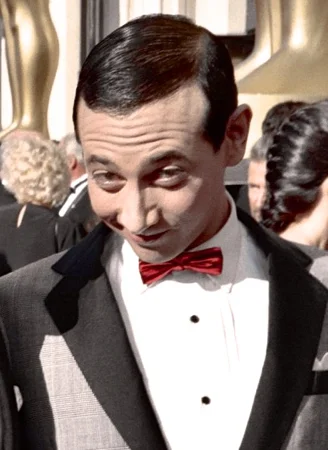
Paul Reubens, better known as Pee-wee Herman, died last week at the age of 70. Reubens’s career began in improv as a member of the Groundlings. In 1981 he created the character of Pee-wee Herman, a “man-boy” who starred in movies, tv shows, Broadway theater, and late night television. His children’s program Pee-wee’s Playhouse, an Emmy award winning series, had him living in a vast fantasy world of talking chairs, robots, a disembodied genie’s head, clay animation, and a cast of characters played by Phil Hartman and Laurence Fishburne among others. He was loved for his fantastical quotes, including his response to being insulted by another: “I know you are, but what am I?” While personal scandal marred his career, Reubens, as Pee-wee Herman and in other roles, was considered to be a unique and multi-talented performer whom Jimmy Kimmel called “a brilliant and original comedian who made kids and their parents laugh at the same time.” Reubens was Jewish, but rarely referenced his Jewish background in his work or public life. What was a specific Jewish connection in his life?
Pee-Wee Herman (1988) by Alan Light is licensed under CC BY 2.0 via Wikimedia Commons
A.Reuben’s father Milton Rubenfeld was an American rabbi in Sarasota, Florida. Reubens noted in an interview that one of the inspirations for his Pee-wee Herman character was his father, who used to visit his synagogue’s nursery school every Friday for a Shabbat program where he would sit on the floor with the children and play games, using funny voices and silly hats to engage the children.
B.Reuben’s father Milton Rubenfeld was a pilot for the British Royal Air Force as well as the United States Army who later was a founding member of the Israeli Air Force. When his plane was shot down during the 1948 War for Independence, he bailed out and landed in the Mediterranean Sea near the Israeli coast. As he swam to shore, Israelis began to fire at him believing he was an Arab pilot. Not knowing Hebrew, he saved himself by yelling “Shabbos, gefilte fish!”
C.Reubens’s first acting experience was at the Jacobs Camp, a sleepaway camp in Florida under the Reform movement’s auspices. Reubens was cast as Motel Kamzoil in a production of Fiddler on the Roof.
D.Paul Reubens noted in a radio interview that the inspiration for his Pee-wee Herman look was a picture of himself at his bar mitzvah, where he had slicked back hair and was wearing a red bow tie.
E.Among the running gags of Pee-wee’s Playhouse was the line “If you love ‘X’ so much, why don’t you marry it?” This led to an episode where Pee-wee Herman married a salad. Originally the producers planned to have him marry an Italian salad, which included non-kosher pepperoncini. But Pee-wee told the producer that as a Jew he didn’t want to intermarry so he insisted that the wedding be performed with a fruit salad instead.
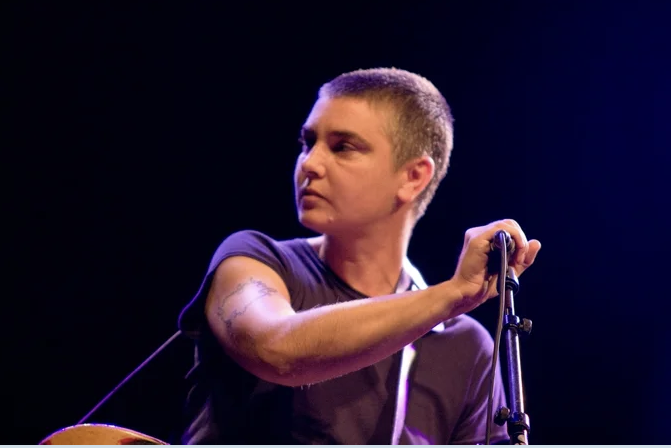
Sinéad O’Connor died last week at the age of 56. She was a highly successful performer, as well as an activist in support of women’s rights and opposed to racism and child abuse.
Sinead O’Connor (3833775149) by Rob D is licensed under CC BY-SA 2.0 via Wikimedia Commons
During a 1992 appearance on Saturday Night Live she performed a moving version of Bob Marley’s song War and then she tore up a picture of Pope John Paul II and stated “fight the real enemy” in reference to the child sexual abuse scandals of the Catholic church.
In what O’Connor called her “Jewish Period,” she studied Kabbalah with a rabbi in England, and she later dedicated her 1997 EP, Gospel Oak, to the people of “Israel, Rwanda, and Northern Ireland.” Her memoir, Rememberings, includes a chapter titled “Shevti Adonai L’Negdi Tamid,” a phrase from the Book of Psalms, which translates as “I place God before me always.” She performed two concerts in the amphitheater in Caesarea in Israel in 1995. What is another Jewish connection in Sinéad O’Connor’s life?
A.In 1984, Sinéad O’Connor spent five months in Israel as a volunteer on Kibbutz Hulata, where she picked citrus fruit and began developing her songwriting skills.
B.O’Connor was scheduled to perform in a peace concert arranged by Israeli and Palestinian women’s groups in Jerusalem in 1997 at a festival called “Two Capitals, Two States,” but she canceled after receiving death threats from members of (now Israeli Minister of National Security) Itamar Ben-Gvir’s Kahanist organization The Ideological Front.
C.Sinéad O’Connor named one of her sons Ne’viim, the Hebrew word for “prophets.”
D.O’Connor’s father John Oliver “Seán” O’Connor was a barrister in Dublin. He worked for a law firm that was headed by a nephew of Israeli president Chaim Herzog, who was was born in Ireland.
E.Rabbi Hyman Krustofsky was a respected rabbi in Springfield, Illinois. But when his son Herschel decided to become a clown the rabbi was angry, as this was not what he considered a proper profession for a Jewish boy, leading the rabbi to disown his son, now known as Krusty. Sinéad O’Connor was in college at the time, and she once performed on campus, singing the song Tears of a Clown, after which she raised a picture of Rabbi Hyman Krustofsky and tore it into many pieces as she uttered the words, “Oy vey, Rabbi. So he’s a clown. Is that such a shonde?”
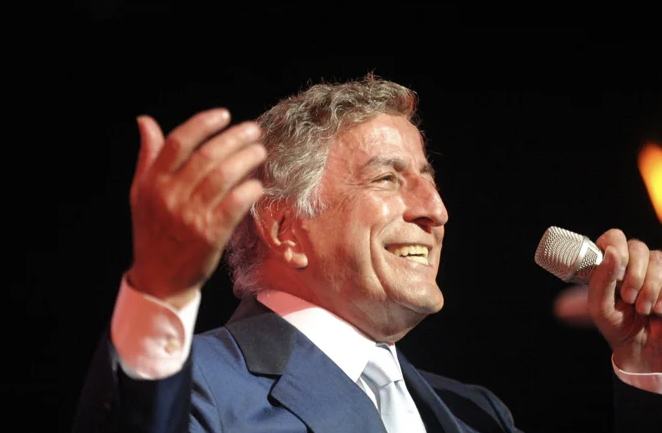
Singer Tony Bennett passed away just two weeks shy of his 97th birthday. In 2014, Bennett performed in Tel Aviv’s Mann Auditorium, one night after a surprise guest appearance at a Lady Gaga performance in Hayarkon Park.
Tony Bennett in 2003 by Tom Beetz is licensed under CC BY-SA 2.0 via Wikimedia Commons
As a United States soldier in World War II, Bennett was among the troops who liberated the Dachau concentration camp. In his autobiography, Bennett wrote, “I’ll never forget the desperate faces and empty stares of the prisoners as they wandered aimlessly around the campgrounds.” He later wrote that this experience “turned me into a lifelong pacifist and it’s my hope that all wars and violence will become a thing of the past.” He remained politically active throughout his life, including walking alongside Dr. Martin Luther King, Jr. during the 1965 Montgomery to Selma protest march. What is a Jewish connection in Tony Bennett’s life?
A.Sammy Davis, Jr. and Tony Bennett not only performed together on many occasions, but were also very close friends. When Davis’s son Sammy Davis III was born, Tony Bennett served as the godfather and held the child during the bris.
B.Bennett participated in Henry Louis Gates’s television program Finding Your Roots and learned that some of his ancestors were Sicilian Jews who converted to Christianity at the time of the Inquisition.
C.Tony Bennett participated in the first Chabad To Life! telethon in 1980, which was hosted by actor Carroll O’Connor and comedian Jan Murray. He sang I Left My Heart in San Francisco as well as Hava Nagilah.
D.Tony Bennett has a Jewish granddaughter named Maya because his daughter Antonia married an Israeli man and converted to Judaism.
E.Cy Coleman (whose real name was Seymour Kaufman) wrote the lyrics for a number of songs popularized by Tony Bennett, including The Best is Yet to Come and I’ve Got Your Number. Coleman also wrote Bennett’s most popular song, I Left My Heart in San Francisco. However, the song was originally written with a different title and lyrics reflecting Coleman’s Eastern European Jewish heritage and his parents’ journey from Slovakia to America. When Tony Bennett heard the song, I Left My Heart in Bratislava, he immediately begged Coleman to rewrite the lyrics to appeal to a broader American audience, and the rest is history.
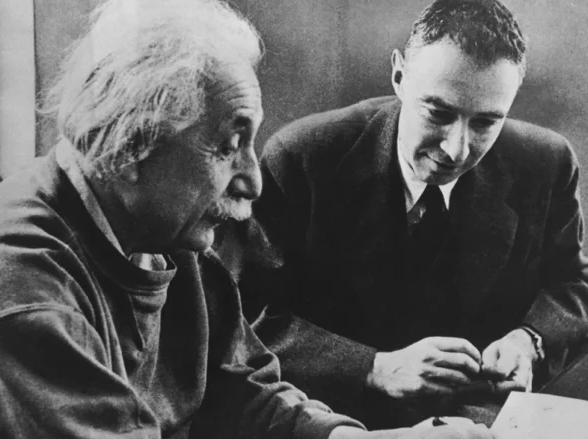
The biographical film Oppenheimer opens this week, telling the story of J. Robert Oppenheimer, son of a Prussian-Jewish immigrant, who became a theoretical physicist and director of the Los Alamos Laboratory during World War II. Oppenheimer is credited as the “father of the atomic bomb” for his role in the Manhattan Project, and he was present in 1945 at the first atomic bomb test. Only a few years later, Israel began its own nuclear program.
Einstein oppenheimer.jpg by US Govt. Defense Threat Reduction Agency is in the public domain via Wikimedia Commons
Prime Minister David ben-Gurion strongly advocated for a nuclear capability to prevent another Holocaust, and he stated, “What Einstein, Oppenheimer, and Teller, the three of them are Jews, made for the United States, could also be done by scientists in Israel, for their own people.” This effort led to the secret building in the late 1950’s of the Negev Nuclear Research Center in Dimona, housing a nuclear reactor and reprocessing plant. United States embassy officials saw the construction taking place when on a helicopter fight over the area, but an Israeli official was able to convince them that the construction was of a textile factory. Israel’s nuclear enterprise remained largely secret until 1986, when a former nuclear technician at the plant, Mordechai Vanunu, released information about Israel’s nuclear program to the press. Though much is still unknown about Israel’s nuclear capability, it is estimated that Israel’s stockpile of nuclear warheads ranges between 80 and 400. When Israel first built the nuclear facility they received major support from France, which provided the nuclear reactor that was installed in Dimona. What assistance did Israel receive from another country in support of their nuclear program.
A.South Africa provided the uranium which enabled Israel to power up the nuclear reactor.
B.Norway provided the heavy water that was needed for the reactor to operate.
C.The plans for the building of the nuclear plant were actually drawn up in the United States by some of the Jewish scientists who worked on the Manhattan Project. They received input from J. Robert Oppenheimer, though his role was not revealed until after his death in 1967.
D.The steam generator which is a major component of the cooling system was provided by Siemens, a German company.
E.Shmattes were sent to Israel from Jewish peddlers on the Lower East Side in New York City. These were strewn around the nuclear plant to fool United States officials who asked to tour the “textile factory” in Dimona.
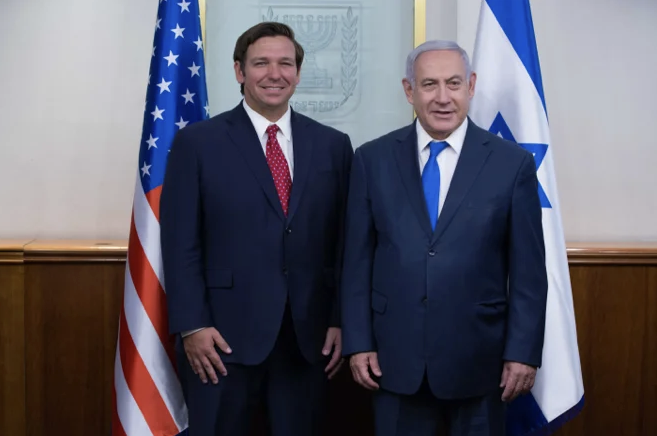
Florida Governor Ron DeSantis, Republican candidate for president, traveled to Israel this past April, having previously visited the country four other times.
Ron DeSantis and Benjamin Netanyahu photo in the public domain via Wikipedia.
He is a strong supporter of Israel, and in 2019 he tweeted that he “promised to be the most pro-Israel Governor in America.” He refers to the West Bank as “Judea and Samaria,” in line with the Israeli right which rejects the idea that the West Bank is occupied territory. He has been a strong advocate against the BDS movement, and his support for school vouchers for private education has garnished great support among the Orthodox community. Regarding Prime Minister Benjamin Netanyahu, DeSantis said “He gave a great speech when I was in Congress…I told him after that speech I had so many constituents who said, ‘Heck why don’t we elect Netanyahu here?’ So, if it doesn’t work out for him, I think he probably could get elected in the United States if he wanted to.” But DeSantis’s support of the so-called “Don’t Say Gay” legislation and “Stop WOKE Act,” as well as his support of book banning across the state, has put him at odds with the majority of Jewish voters in Florida. Following DeSantis’s 2019 trip to Israel, why did he specifically say that he wants to go back to Israel?
A.In an interview with the food writer for the Miami-Dade Jewish News, DeSantis learned that casino magnate and conservative Israel supporter Sheldon Adelson owned the Tel Aviv kosher restaurant West Side, considered one of the top restaurants in the country. “I did not know that,” said DeSantis. “But you can be sure that it’s now on my list of places to go on my next trip to Israel. That’s a great incentive to go back.”
B.When DeSantis visited Israel in 2019, he was scheduled to visit the Church of the Nativity, located on the site in Bethlehem where purportedly Jesus was born. DeSantis, who was born Roman Catholic, had stated that “seeing the place where our Lord entered the world will make my trip to the Holy Land particularly meaningful.” However, because of a terrorist incident which took place near Bethlehem the day before DeSantis’s visit, the trip to the church had to be canceled for security reasons, with DeSantis noting that “The Church has been there for 2000 years. It will remain, and with God’s grace, I will surely be back again.”
C.Speaking to a private meeting of advisors and potential donors in early 2020, DeSantis said, “I plan to run for president, but I know that it won’t be easy to defeat Donald Trump if he runs again. But my record regarding Israel is far stronger and more consistent than his, including the fact that he advocated for a Palestinian state. I plan to go back to Israel early in the campaign where I’ll lock down the Jewish vote with my full-on support for the Jewish state.”
D.During DeSantis’s 2019 trip, he traveled with officials from the Walt Disney company, who were exploring the possibility of supporting the building of a theme park in the Negev under the auspices of the Ministry of Tourism. DeSantis and Disney CEO Robert Iger held a press conference following their meeting with Yariv Levin, the Tourism minister, where DeSantis stated that he “looked forward to returning to the Holy Land for the grand opening of the Disney Negev.” Ultimately, however, Disney withdrew from the project, which is still moving forward as Negev Park, with plans to open by 2030.
E.On an earlier trip to Israel, DeSantis had brought back a bottle of water from the Sea of Galilee, some of which he used for the baptism of his son Mason in early 2019. But afterwards, a cleaning crew threw away the unlabeled bottle, not realizing what it was. Said the governor, “Now, we don’t have any bun in the oven right now. But I think we do need to go back to Israel to make sure we have a stock of that water on display.”
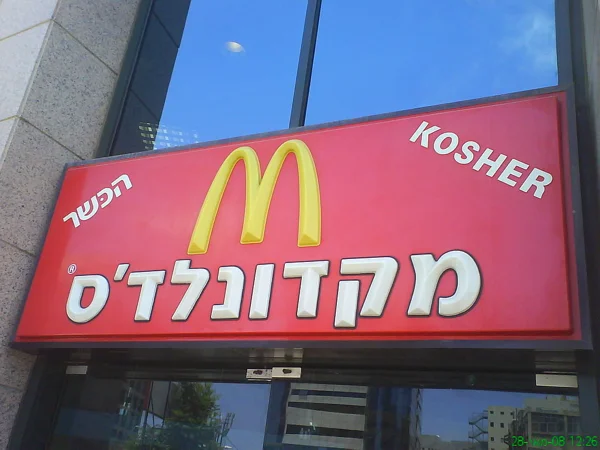
Kosherpalooza, a food festival featuring kosher dairy and meat items, cooking demonstrations, wine tastings and more, was recently held for the first time at the Meadowlands Expo Center in New Jersey. Thousands of attendees sampled dried pink pineapple, miniature steak tartares served in crispy tapioca shells, CBD peanut butter cups, and more.
Kosher McDonald’s restaurant in Ramat-Gan by Otto Magnus is licensed under CC BY-SA 3.0 via Wikimedia Commons
Meanwhile, new kosher restaurants are opening across the country, including Vitali’s Kitchen, a dairy cafe in Minnesota’s Mall of America, Anita’s Gelato, a popular Israeli chain that has opened a location in the Los Angeles suburb of Tarzana, and Smash House, a burger joint which just opened its second location in Florida. What other new kosher restaurant is generating a lot of buzz in the Jewish community.
A. Masuda Omakase, which had previously offered in-home kosher sushi catering, has now opened a dine-in location in midtown New York. The restaurant features fresh crispy hand rolls with fish flown in from Japan.
B. Guy Fieri opened a kosher branch of his restaurant chain Chicken Guy! in North Miami Beach. The fast food restaurant serves the chicken tenders and bowls that are offered at all of their locations; the primary difference is the lack of a cheese option in their sandwiches and bowls.
C. Veal Chop Sticks, a kosher Chinese restaurant, opened in April in Lakewood, New Jersey, which is the home of Beth Medrash Govoha, the largest Yeshiva in the United States. The community had been without a kosher Chinese restaurant since the Cho-Sen Kitchen had closed during the pandemic in 2021.
D. Ee Efshar is a new kosher dairy restaurant that opened in the Williamsburg section of Brooklyn. Ee Efshar is Hebrew for “impossible,” and the restaurant features menu items made with the Impossible Foods company products such as Impossible beef, Impossible sausage, and Impossible chicken tenders, all of which are plant-based products that can be served with dairy foods. Featured on the restaurant’s menu are lasagna, cheeseburgers, beef and cheddar casserole, and meat and cheese quesadillas, along with other traditional meat and dairy recipes which cannot normally be eaten by observant Jews.
E. Mocha Burger Lux opened in New York City, offering a “24K Gold Plated Golden-Burger” for $175, consisting of a 12 ounce short rib burger wrapped in leaves of 24-karat gold, topped with black Australian truffles, crunchy onions and pickles, and served in a smoke-spewing wooden treasure chest.
Sheldon Harnick, lyricist of Fiddler on the Roof, Fiorello!, and other Broadway shows, died last week at the age of 99. Harnick and composer Jerry Bock wrote many songs for Fiddler on the Roof which did not end up in the final version of the show, including “We’ve Never Missed a Sabbath Yet,” which was originally planned as the opening number. Director Jerome Robbins kept pushing the writers for something which would better tell what the show was about.
Lyricist Sheldon Harnick circa 1995. (Michael Ochs Archives/Getty Images)
At one point Harnick said with great frustration, “Oh, for God’s sake Jerry, it’s about tradition!” To which Robbins responded, “That’s it! That’s what [it’s] about. Write the opening number.”
What other song written by Harnick and Bock did not meet with the approval of director Robbins and was cut from the show?
A.Prior to the writing of the song Anatevka, which comes at the end of Fiddler on the Roof as Tevye’s family and others lament leaving their village, there was another song that was proposed. The title was “The Exodus,” where each character sang about where they were going (to Israel, to stay with Uncle Avram in America, etc.). The chorus of the song included the lines, “When Israel was in Egypt Land/You led us through the desert sand/To Yisrael, the promised land/Now once again, please guide our hand.” But Jerome Robbins decided that it would be better to focus on where and what they were leaving rather than where they were going.
B.When Lazar Wolf met with Tevye to ask him for his daughter Tzeitel’s hand in marriage, Tevye replied, “Why should I give my daughter to a coarse, crude, butcher? A man like you, a man with no soul?” Lazar Wolf responded, singing a song titled “A Butcher’s Soul.” But Jerome Robbins decided that this scene needed to focus on Tevye, not Lazar Wolf.
C.At the end of Fiddler on the Roof, as everyone prepares to leave Anatevka, Tevye refuses to acknowledge his daughter Chava and her Russian husband Fyedka. Fyedka says to Tevye, “Some are driven away by edicts, others by silence.” Originally, Harnock and Bock wrote a short response to Fyedka that Tevye sang, including the lyrics “Chava has fled from us/Chava is dead to us,” reprising his words about Chava when Golde first told him she had married Fyedka. But Jerome Robbins felt that the verse was too harsh, and he replaced it with Tevye’s simple statement, “God be with you.”
D. “If I Were A Woman,” a duet featuring Perchik and Hodel, was a song in which the two were arguing, but clearly showed they were attracted to each other. Jerome Robbins cut the song, saying, “…the show is too long. And I can accomplish the same thing in 30 seconds of dance.”
E.Though Tevye had five daughters, the play focused on the relationships of the oldest three–Tzeitel with Motel Kamzoil, Hodel with Perchik, and Chava with Fyedka. Early in its production, the show featured a duet sung by the two youngest daughters, Shprintze and Bielke, complaining that they were being ignored. The song, entitled “What Are We, Chopped Liver?” was cut, because, yes, in the grand scheme of things, they were chopped liver.
Daniel Ellsberg, the military analyst who leaked the Pentagon Papers to the New York Times in 1971, died last week at the age of 92. Ellsberg’s parents were of Russian Jewish descent, but they had embraced Christian Science and raised him in that tradition. However, he noted that “My parents always said we’re Jewish, but not in religion.” The Pentagon Papers detailed failures and lies of the Lyndon Johnson administration regarding the war in Viet Nam. Ellsberg was charged under the Espionage Act (the same Act under which Donald Trump has been charged), though the charges were eventually dismissed when it was revealed that members of President Richard Nixon’s White House staff had made unlawful efforts to discredit Ellsberg. About Ellsberg, Nixon said, “You can’t let the Jew steal that stuff and get away with it. You understand? People don’t trust these Eastern establishment people. [Ellsberg is] Harvard. He’s a Jew. You know, and he’s an arrogant intellectual.” In response, Ellsberg said, “I was a Jew and I am a Jew. By [President Richard Nixon’s] definition, I’m 100 percent a Jew, as I would be under Hitler’s.” What was the one occasion where Daniel Ellsberg was in a synagogue?
Daniel Ellsberg in 1972. Photo Credit: Gotfryd, Bernard, photographer, Wikipedia Commons
A.Ellsberg’s second wife Patricia Marx was Jewish, and her father had been an esteemed member of Temple Emanu-El in New York City. When he died, the funeral was held at the synagogue and Ellsberg attended.
B.While Ellsberg’s parents practiced Christian Science, his parents’ siblings remained Jewish. As a child, Ellsberg attended the bar mitzvah of his first cousin Ben Ellsberg, son of Daniel’s Uncle Edward.
C.Ellsberg told journalist James Rosen that the one time he ever entered a synagogue was to give a lecture about the Pentagon Papers.
D.Ellsberg attended the wedding of his friend Morton Halperin at the Adas Israel Congregation in Washington DC. Halperin had overseen the production of the Pentagon Papers for Defense Secretary Robert McNamara.
E.Ellsberg snuck into a synagogue in the Pechev shtetl in Poland to investigate a scandal wherein a young woman adopted the name Anshel and posed as a male yeshiva student who then married a woman named Hadass while falling in love with another student named Avigdor, who had been Hadass’s fiancé. Ellsberg was able to publish documents he found exposing the scandal which was known as the Yentl-gon Papers.
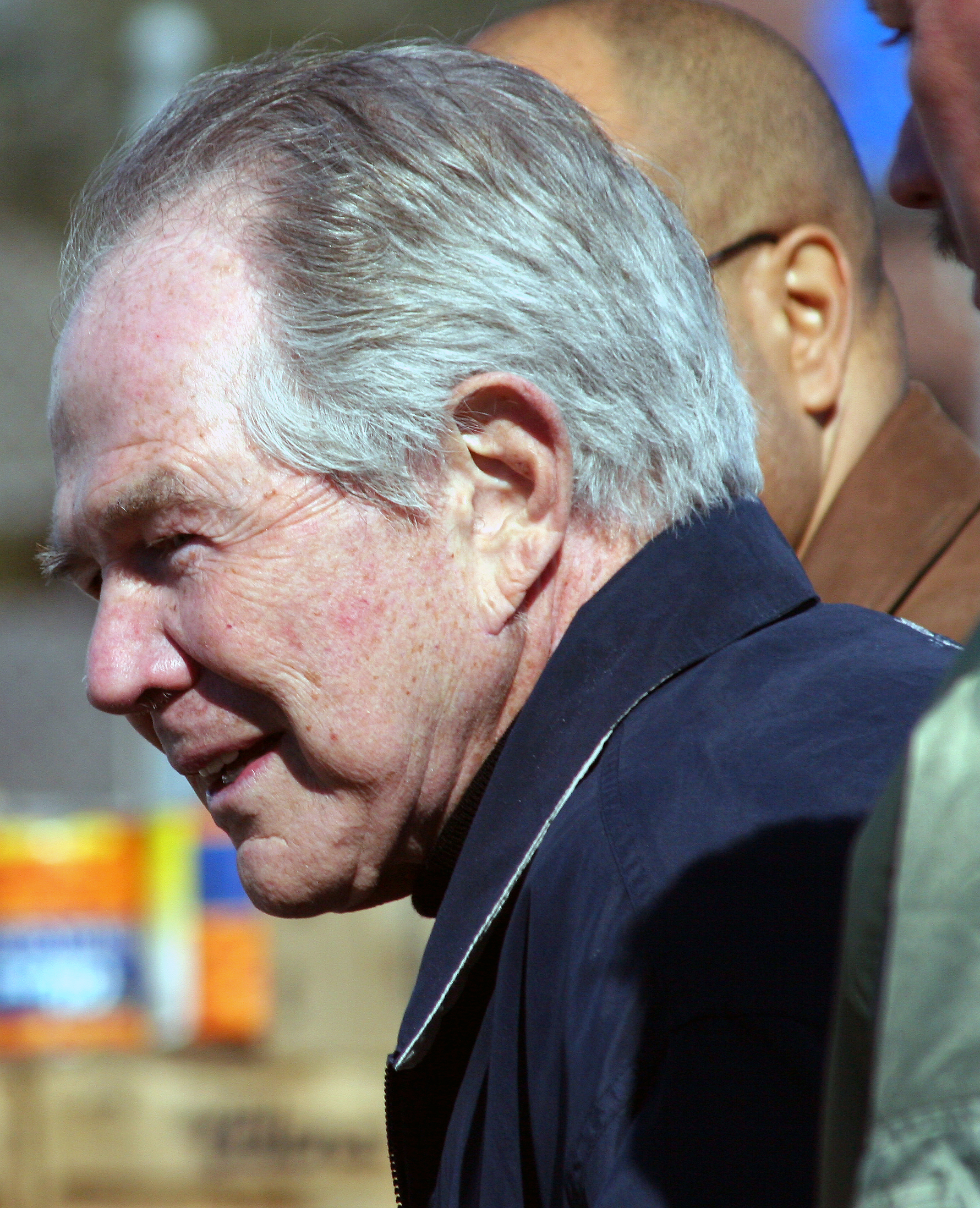
Pat Robertson Paparazzo Photography by Paparazzo Presents is licensed under CC BY-SA 3.0 via Wikimedia Commons
Pat Robertson, the controversial Baptist minister who preached a conservative brand of political Christianity, died last week at the age of 93. Robertson was the founder of the Christian Coalition and he helmed The 700 Club television broadcast, promoting his vision of America as a Christian nation. Robertson was a strong supporter of Israel and many Jewish causes, including freedom for Soviet Jewry. Prime Minister Benjamin Netanyahu tweeted that Robertson “was a great friend of Israel, second to none.”
But Robertson was a controversial figure in the Jewish community. In a 2014 conversation on The 700 Club with Rabbi Daniel Lapin, Robertson said, “What is it about Jewish people that make them prosper financially? You almost never find Jews tinkering with their cars on the weekends or mowing their lawns.” Rabbi Lapin concurred, at which point Robertson noted that Lapin would be busy “polishing diamonds, not fixing cars.” What other statement did Pat Robertson make that was controversial within the Jewish community?
A.When Israeli Prime Minister Ariel Sharon suffered a stroke, Robertson claimed that God punished Sharon for withdrawing Israel from the Gaza Strip, stating, “God considers this land to be his…and for any prime minister of Israel who decides he is going to carve it up and give it away, God says, ‘No, this is mine.’”
B.Referring to the effort by liberal Jews to provide a place at the Western Wall for egalitarian prayer, Robertson said, “a condition like this will bring about the destruction of your nation. It’ll bring about terrorist bombs; it’ll bring earthquakes, tornadoes, and possibly a meteor.”
C.Referring to the Gaza Strip under the control of Hamas, he said, “Maybe we need a very small nuke thrown off there to shake things up.”
D.Following a molotov cocktail attack on a gay bar in Tel Aviv by an Orthodox Jew, Robertson said, “I really believe that the pagans, and the abortionists, and the feminists, and the gays and the lesbians who are actively trying to make that an alternative lifestyle—all of them who have tried to secularize Israel–I point the finger in their face and say: ‘You helped this happen.’”
E.After passing a synagogue in Brooklyn as their Purim celebration was spilling out into the streets, Robertson said, “I think we ought to close Purim down. Do you want your children to dress up as witches? The Druids used to dress up like this when they were doing human sacrifice…Your children are acting out Satanic rituals and participating in it, and don’t even realize it.”
Padma Lakshmi announced last week that she is leaving the Top Chef program after serving as host and judge for 20 seasons of the cooking competition show. Lakshmi, born in Madras (now Chennai), India, has a varied professional background, first as a model and later as an actor. She has created, hosted, produced and/or performed in numerous television shows and movies, including Taste the Nation with Padma Lakshmi, Padma’s Passport, Glitter, Whose Line Is It Anyway?, and 30 Rock. She has written many food-related books, including The Encyclopedia of Spices and Herbs: An Essential Guide to the Flavors of the World and Love, Loss, and What We Ate: A Memoir. What is a Jewish connection in Padma Lakshmi’s life?
Padma_Lakshmi.jpg by Arthur from Westchester County north of NYC, USA is licensed under CC BY-SA 2.0 via Wikimedia Commons
A.Lakshmi’s daughter Krishna (whom Lakshmi calls Little Hands) celebrated her bat mitzvah last year. Krishna’s father, Adam Dell (venture capitalist and brother of Dell Computer founder Michael Dell) is Jewish. Said Lakshmi about her daughter, “She’s a big girl, she just turned 12. She also got her nose pierced recently and looks fantastic.”
B.Among the cookbooks that Lakshmi published is Calcutta Kosher: The Cuisine of India’s Jewish Community, which she co-wrote with Mavis Hyman (best known for her cookbook Indian-Jewish Cooking).
C.Lakshmi and author Salman Rushdie were in a relationship for about 8 years (including a three year marriage). Lakshmi introduced him to Philip Roth, author of Portnoy’s Complaint and Goodbye, Columbus, as she had gotten to know him when she performed in a stage version of Goodbye, Columbus in London. The two authors developed a deep friendship, and Rushdie credits Roth for helping him create Jewish characters in a number of his novels. Among those were Mimi Mamoulian, the Jewish friend and foil of Saladin, the main character in The Satanic Verses and Max Ophuls, the Jewish war hero who is at the center of Rushdie’s novel Shalimar the Clown.
D.In a 2006 ABC miniseries, The Ten Commandments, Lakshmi played Bithia, daughter of the Pharaoh. Bithia took in baby Moses and raised him as her son after Moses’s mother Jochebed placed him in a basket in the Nile River to save him from the Pharaoh’s edict that all Jewish newborn males must be killed.
E.Ilan Hall, a Jewish chef from Great Neck, New York, was the winner of the second season of Top Chef. His parents were both Jewish, with his father from Scotland and his mother from Israel. Among the season’s highlights were the many times Lakshmi asked Hall to help her as she struggled to pronounce such food names as arbroath smokies, kreplach, cullen skink, cholent, haggis, gribenes, cranachan, and kasha varnishkes.